

Power’s out. You’re standing in the dark wondering whether you’ve got a blown fuse, a tripped safety switch, or something more serious. Before you start flicking switches randomly, let’s work through this safely and get your lights back on.
Is This an Emergency? Immediate Safety Check
A blown fuse is a safety mechanism doing its job. It is not usually an emergency. But certain signs mean you need to step away from the switchboard immediately.
Stop. Do not touch the switchboard if:
- You smell burning plastic or a strange “fishy” odour
- The fuse box feels hot
- You can see black scorch marks around switches or wiring
- There’s visible smoke or sparks
Any of these? Call 000 or an emergency electrician right now. Do not attempt anything yourself.
If none of those warning signs are present, you’re safe to work out what you’re dealing with.
What Kind of Switchboard Do You Have?
Before anything else, look at your board from a safe distance. Australian homes typically have one of three setups, and what you can do next depends entirely on which one you’re looking at.
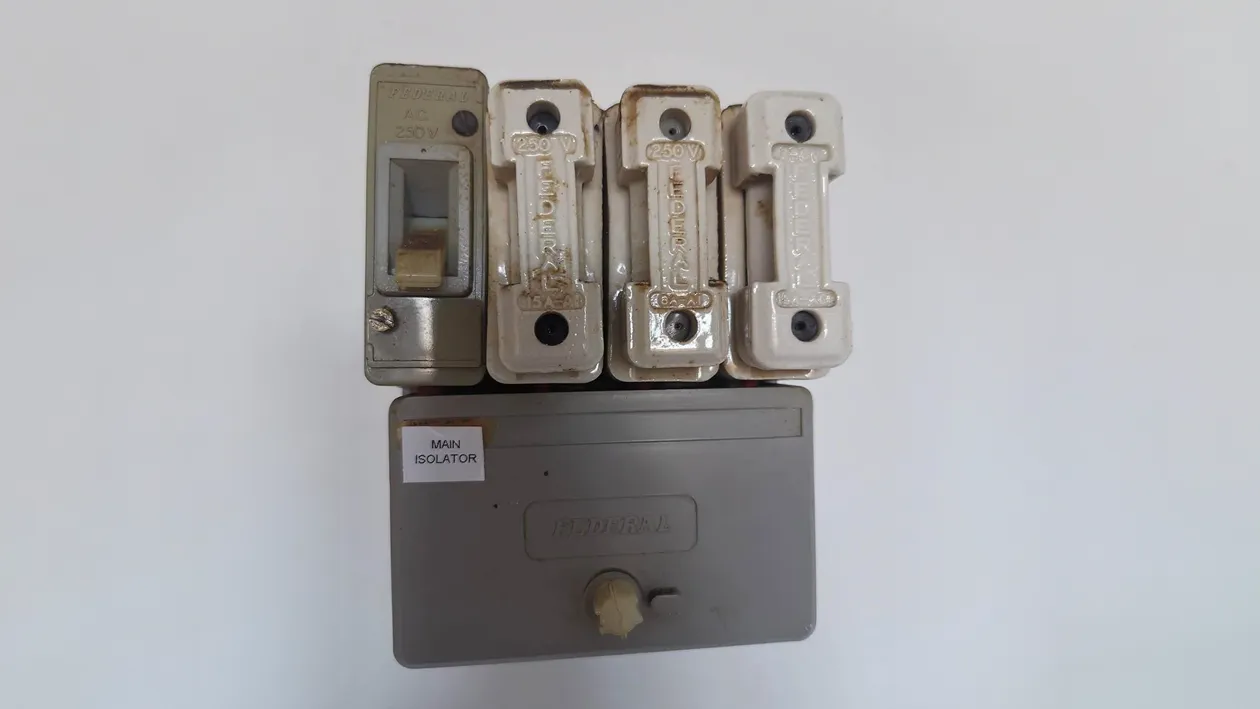
- Ceramic fuse wedges – Older homes, generally pre-1990s. Small porcelain blocks that pull out of the board. If this is what you’ve got, everything from here on is a job for a licensed electrician.
- Circuit breakers – Toggle switches that flip off when a circuit is overloaded.
- Safety switches (RCDs) – Usually have a “test” button. These protect against electric shock, which fuses and circuit breakers do not.
Most homes built after the 1990s have circuit breakers and safety switches. Older homes may still run on ceramic fuses, or a mix of both.
If you are looking at ceramic fuses, that is worth knowing about in its own right. They protect your wiring but they do nothing to protect you, and they are the reason a lot of Sydney homes are one faulty appliance away from a serious shock. We’ve covered why ceramic fuse boards should be replaced in detail.
How to Tell if a Fuse or Breaker Has Tripped
For circuit breakers: look for the switch sitting in the “OFF” position (flipped down), or stuck halfway between ON and OFF. That’s your culprit.
For safety switches (RCDs): these look similar to a breaker but have a test button. A tripped RCD means the circuit has an earth leakage fault, which is a different problem to an overload. It usually means an appliance is faulty.
For ceramic fuses: you cannot reliably tell from the outside. Hairline breaks in the fuse wire are not always visible, and opening the board to check is not homeowner work. If your board has ceramic fuses and a circuit is dead, call an electrician.
Resetting a Tripped Circuit Breaker
If you’ve got a modern board, this part is straightforward.
- Unplug the appliance you were using when the power cut out. Kettles, heaters and hair dryers are common triggers.
- Find the tripped switch on your switchboard. It will be in the OFF or middle position.
- Push it firmly to OFF (all the way down), then flip it back to ON.
If the breaker trips again straight away, stop. You’ve got a hard short somewhere in the circuit, and that is a job for a licensed electrician.
Note: if the tripped switch has a test button (an RCD or safety switch), it can be harder to reset. You often need to push it firmly all the way OFF before it will latch back ON.
Why You Cannot Replace Fuse Wire Yourself in NSW
This is the question we get most often from people with older boards, so it’s worth being clear about it.
In NSW, electrical wiring work must be carried out by a licensed electrician. The exemptions for homeowners are narrow: changing a light bulb, plugging in a portable appliance, replacing a plug-in fuse. Rewiring a ceramic fuse carrier inside your switchboard is not on that list. It is work on the fixed installation, and doing it yourself is both illegal and genuinely dangerous.
There’s a practical reason the rule exists, and we see the consequences of it regularly. A rewirable fuse is only as good as the wire someone last threaded into it. Fit wire that’s too thick and the fuse stops doing its job entirely. The circuit will happily carry more current than the cable behind your wall is rated for, and the first sign of trouble is the wall getting hot. A fuse that never blows looks exactly like a fuse that works.
If your board still has ceramic fuses and one has blown, call us. It is a small job, and it is also a good moment to find out whether the board itself is the real problem.
Why Does My Fuse Keep Blowing?
If the same circuit keeps dropping out, the fuse is not the problem. It is the messenger. Something on that circuit is drawing more than it should.
Common causes:
- Circuit overload – Too many high-draw appliances running at once. Hot water systems, dryers and kettles on the same circuit will trip it every time. To see how much load your circuit can safely carry, our electrical load capacity calculator walks you through the maths.
- Faulty appliance – A short circuit inside a toaster, kettle or older appliance. These are frequent offenders.
- Wiring fault – Damaged insulation, rodent damage, or deteriorating connections inside walls. Older homes with VIR cable are particularly prone to this. It needs a professional.
The unplug test: unplug everything on the affected circuit. Reset the breaker. Then plug appliances back in one at a time. When it trips again, you’ve found your faulty appliance.
When to Call an Electrician
Safe to do yourself:
- Resetting a tripped circuit breaker
- Unplugging appliances to isolate a faulty one
Call a licensed electrician:
- Your switchboard uses ceramic fuses or rewirable fuse wire of any kind
- A breaker trips again immediately after resetting
- Multiple circuits are affected
- You can see damage, scorching or melted plastic
- A safety switch keeps tripping and you cannot find the appliance causing it
- The fault is on the street pole or service line, which requires a Level 2 electrician. Your network provider (Ausgrid, Endeavour) typically handles these.
Not sure whether the switchboard is really the cause? An electrical safety inspection tests the whole installation and tells you whether you need a full upgrade or just a targeted repair.
What Does It Cost?
Diagnosing and fixing a blown fuse is usually a small job. The underlying problem is what determines the cost.
If your home still runs on ceramic fuses, this is the moment to think seriously about a switchboard upgrade. Standard ceramic fuse to RCD conversions start from $450 on a single-phase board. Larger homes with more circuits, or 3-phase conversions, cost more. We quote per job, not per hour, so you’ll know the price before we start.
Modern circuit breakers and safety switches offer far better protection, reset in seconds, and remove the possibility of anyone ever putting the wrong wire in a fuse carrier again.
What to Do Next
A tripped breaker is usually a two-minute fix. Reset it, find the appliance that caused it, and you’re back in business.
But if the fuse keeps blowing, the breaker keeps tripping, or you spot any warning sign like a burning smell or scorch marks, that’s your switchboard telling you something is wrong. And if you’re still on ceramic fuses, the board is overdue regardless of whether anything has blown.
Moonlight Electrical is family owned and operated, Level 2 ASP accredited, and available 24/7 across Western Sydney and greater Sydney. Every job is backed by our Lifetime Labour Guarantee and issued with an Electrical Certificate of Compliance where required.
Call 0401 019 632 or get in touch and we’ll get your power back on properly.