

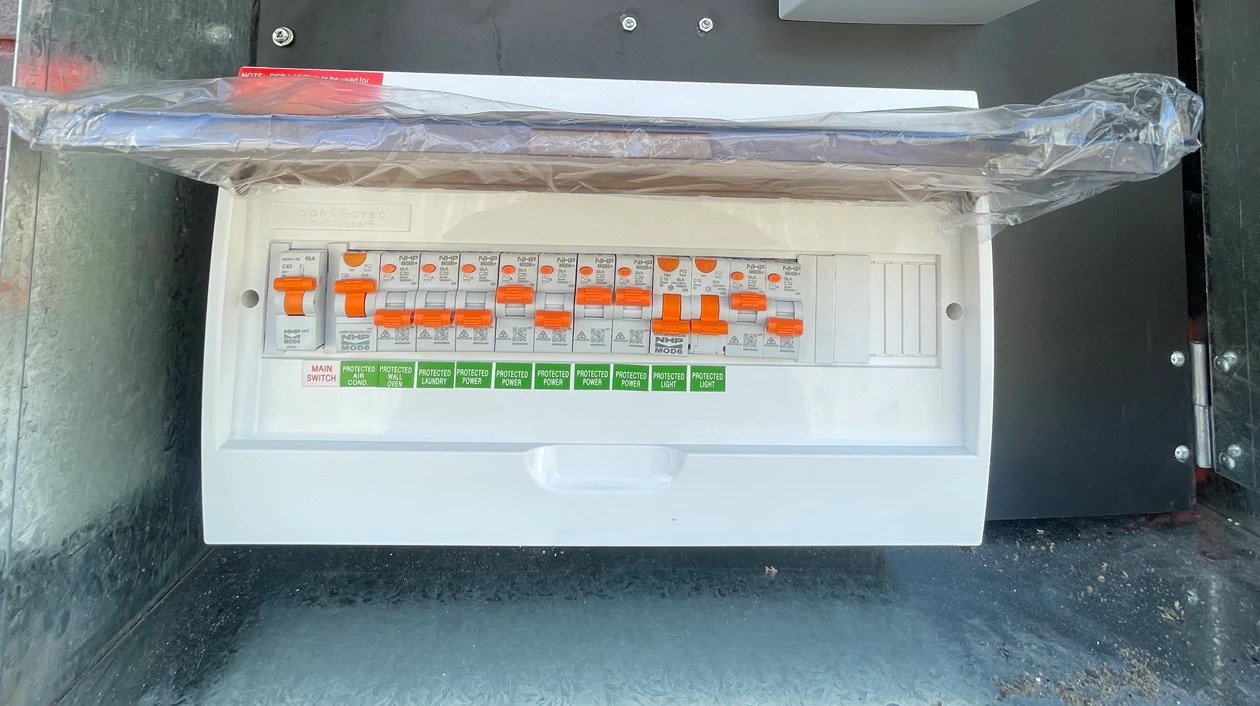
Electrical load capacity is the maximum amount of electricity your home’s wiring, switchboard, and circuit breakers can safely carry at one time. In Australia, a standard single-phase home is typically supplied with between 40 and 63 amps, or roughly 9.6 kW to 15 kW of usable power. When you ask too much of that system, breakers trip, wiring overheats, and in worst-case scenarios, you start a fire inside your wall cavity.
This guide gives you the practical tools to understand what your home can handle, how to calculate the load you’re actually drawing, and how to spot when a circuit is heading toward trouble. It’s written for Australian homes (240 V, AS/NZS 3000 wiring rules), and we’ve kept it plain, with no jargon left unexplained.
If you’ve already got a tripping breaker, burning smell, or warm powerpoint, skip the reading and call us. Moonlight Electrical answers 24/7 on 0401 019 632. Emergency callouts across Sydney, with a Level 2 ASP on the truck.
How to tell if a circuit is overloaded
A circuit is overloaded when the total amps drawn by everything plugged into it exceeds the rating of the breaker protecting it. Plug a 2,400 W heater, a 2,000 W kettle, and a 1,000 W microwave into the same kitchen circuit, and you’ve asked a 20-amp breaker to carry roughly 22.5 amps. It will trip, and that’s the system doing its job. The problem is when it trips repeatedly, runs hot in between, or has been silently overloaded for years on a circuit without a working safety switch.
The 3-minute self-assessment
Walk through these three checks before you call anyone:
Check 1 (Visual): Do your lights dim or flicker?
Switch on a high-draw appliance (kettle, vacuum, hairdryer, reverse-cycle aircon). If the lights in the same room dim noticeably or flicker for more than a half-second, that circuit is being pulled close to its limit. Occasional flicker on a kettle is normal. Consistent, every-time dimming is not.
Check 2 (Tactile): Are any wall plates, powerpoints, or cords warm?
Touch the wall plate around your powerpoints and switches. They should feel room temperature. Warm is a warning. Hot is an emergency. Unplug everything from that powerpoint immediately and don’t use it again until an electrician has inspected it. Discoloured or yellowed plate? Same rule.
We saw a textbook example of this on a job in Parramatta in 2025. A family called us after the kids mentioned the dining room powerpoint felt warm when they unplugged their gaming console. Nothing dramatic, just enough warmth to notice. When we pulled the faceplate off, the back of the socket was charred around the active terminal. The powerpoint had been running a daisy-chain of TV, console, soundbar, and a portable heater for at least two winters, which is exactly why some appliances should never share a powerpoint or surge protector. No breaker had ever tripped because the steady-state load was sitting just under the cut-off, but the insulation behind the wall had been quietly degrading the whole time. The fix was a new powerpoint, a thermal check of the cable back to the switchboard, and splitting that load across a second circuit. If anyone in your house has mentioned warmth from a socket, get someone in. It’s almost never nothing.
Check 3 (Panel): Is the same breaker tripping repeatedly?
Open your switchboard and have a look. If the same breaker has tripped two or more times this month, especially with the same appliance combination, that circuit is either overloaded or the breaker itself is faulty. Don’t keep resetting it and hoping. Each reset of an overloaded circuit stresses the wiring further.
Action plan if you’ve ticked any of the three
- Unplug the heaviest-drawing appliances on that circuit and see if the trip stops.
- Move high-load devices (portable heaters, kettles, irons) to a powerpoint on a different circuit.
- If the breaker still trips with nothing drawing heavy load, or you smelled anything burning, call a licensed emergency electrician straight away. This isn’t a DIY fix.
How to calculate your home’s electrical load (in kW and amps)
To calculate the load on any circuit, add up the wattage of every appliance running at the same time, then divide by your supply voltage. In Australia we run on a 240-volt system, so a 2,400 W heater draws 10 amps (2,400 W ÷ 240 V = 10 A). A 4,800 W induction cooktop on a dedicated circuit pulls 20 amps. The cardinal rule: never exceed 80% of a breaker’s rating for continuous loads. More on why in a moment.
The load calculation worksheet
Use this on any circuit in your home, whether that’s the kitchen, the garage, or the aircon circuit. It works the same way every time.
Step 1: Map the circuit
Look at the breaker in your switchboard. It will say something like 16 A or 20 A. Multiply that rating by 240 V to get the absolute maximum wattage the circuit can carry. A 20-amp breaker × 240 V = 4,800 watts of theoretical maximum capacity.
Step 2: Apply the 80% safety margin
Multiply that theoretical maximum by 0.80. For our 20-amp circuit: 4,800 W × 0.80 = 3,840 W of safe continuous capacity. This is the figure you actually work to.
Step 3: Tally the load
Add up the wattage of every appliance that runs simultaneously on that circuit. Wattage is printed on a sticker on the back or underside of most appliances. Quick kitchen example:
| Appliance | Typical wattage | Amps drawn (at 240 V) |
|---|---|---|
| Microwave (high) | 1,200 W | 5.0 A |
| Electric kettle | 2,000 W | 8.3 A |
| Toaster (4-slice) | 1,800 W | 7.5 A |
| Fridge (compressor cycle) | 500 W | 2.1 A |
| Dishwasher (heating cycle) | 1,800 W | 7.5 A |
| Total if all run together | 7,300 W | 30.4 A |
Electrical Load Capacity Online Calculator
Step 4: The verdict
Compare your tally to your safe limit (Step 2). In the kitchen example above, 7,300 W is nearly double the 3,840 W safe capacity of a 20-amp circuit. Running all of those together will trip the breaker, and if it doesn’t, the wiring is being cooked. This is exactly why most Australian kitchens need either a dedicated circuit for the oven and cooktop, or a switchboard upgrade if you’re routinely running multiple high-draw appliances at once.
Try this now: the 30-second kitchen test
Walk to your kitchen. Look at the wattage sticker on the back of your kettle, toaster, and microwave. Add the three numbers together.
If the total is more than 2,400 W, those three appliances should not be running on the same double powerpoint at the same time. A standard 10-amp Australian powerpoint maxes out at 2,400 W, and that’s before you add the 80% safety margin.
If you’ve been routinely running kettle + toaster + microwave together on the same powerpoint, you’ve been overloading it. Time for a quote on a kitchen circuit upgrade.
Common mistakes when calculating load
Confusing kVA with kW
kVA (kilovolt-amperes) is apparent power; kW (kilowatts) is real power. The difference matters for motors, transformers, and three-phase commercial loads, but for everyday household appliances on a single-phase supply you can treat them as the same: 1 kW = 1,000 W. Don’t lose sleep over it.
Forgetting about continuous vs intermittent loads
A kettle runs for two minutes. A reverse-cycle aircon on a 35° Sydney day runs for hours. The 80% rule exists because circuits handle a brief peak load just fine. What damages them is sustained heat over a long period. Always apply the 80% rule to anything that runs for three hours or more.
Ignoring the starting current of motors
Aircons, refrigerators, pool pumps, and power tools draw a startup surge of 3 to 7 times their running wattage for a fraction of a second when they kick on. This is why your lights dim when the fridge compressor cycles. A circuit that’s already running near its limit can trip on these brief surges even if the steady-state load is within spec.
Can you plug a 10-amp appliance into a 15-amp powerpoint in Australia?
Yes, you can plug a standard 10-amp appliance into a 15-amp powerpoint. The earth pin on a 10-amp plug fits the larger 15-amp earth socket without trouble. What you cannot do is the reverse: a 15-amp appliance (caravans, large welders, industrial compressors, some EV chargers) will not fit into a standard 10-amp wall powerpoint. The earth pin is deliberately oversized so you physically can’t plug a heavy appliance into a circuit that isn’t rated to carry it. This is a safety feature, not a manufacturing quirk.
Australian single-phase powerpoint comparison
| Spec | 10 A (standard) | 15 A (heavy-duty) | Whole house (single-phase main) |
|---|---|---|---|
| Maximum wattage | 2,400 W | 3,600 W | ~15,000 W (63 A main) |
| Visual identifier | Standard three flat pins | Same shape, oversized earth pin | Main switch in the meter box |
| Typical use | TVs, fridges, chargers, lamps | Large aircon, welders, some EV chargers, caravans | Whole house (most NSW homes) |
| Common circuit breaker | 16 A or 20 A shared | 20 A dedicated | 63 A main switch |
The decision flow: do you need a new dedicated circuit?
- Is the appliance you’re installing rated above 2,400 W? If no, a standard 10-amp powerpoint will handle it.
- Is it above 2,400 W but below 3,600 W? You need a 15-amp powerpoint on a 15-amp dedicated circuit, but only if the appliance’s plug matches it.
- Is it above 3,600 W (large EV charger, ducted aircon, induction cooktop)? You need a dedicated circuit run from the switchboard, sized to the appliance. This is usually 20 A or 32 A, and may trigger a switchboard upgrade or a consumer mains upgrade if your existing supply can’t carry the extra demand.
There is no adapter that legally or safely converts a 10-amp socket into a 15-amp one. Anyone selling you a “15-to-10” adapter is selling you a hazard. If your appliance won’t fit, you need new wiring, not a workaround. We do these dedicated circuits and switchboard upgrades every week across Sydney. Call us on 0401 019 632 for a per-job quote.
What is the 80% electrical load rule?
The 80% rule states that a circuit breaker should only carry 80% of its rated capacity for continuous loads, defined in the Australian Wiring Rules (AS/NZS 3000) and most international standards as any load running for three hours or more without interruption. Flip the same maths around and you get the 125% rule: your breaker size must be at least 125% of your expected continuous load. Same rule, different angle.
Key takeaway
If you have a 15-amp circuit, only plan to draw 12 amps on it continuously (15 × 0.80 = 12). If you need 20 amps of continuous power for an appliance, you don’t buy a 20-amp breaker. You buy a 25-amp breaker and the matching cable thickness (20 × 1.25 = 25).
Why this rule exists: the real-world consequence
Heat is the enemy of electrical wiring. Push a cable to 100% of its rating for hours on end and the insulation around it starts to degrade. PVC insulation slowly hardens, cracks, and eventually exposes the live copper conductor. When that happens inside a wall cavity, you’ve got two problems: an electrical fault that may not trip the breaker (because the bare wire is touching timber or insulation batt, not earth), and a heat source resting against combustible material.
If your home was wired before the 1960s, particularly if you’ve still got the original rubber-and-cotton VIR cable in any circuit, that degradation timeline is dramatically shorter, sometimes measured in years rather than decades. Fire and Rescue NSW data consistently shows electrical faults, including overloaded circuits and degraded wiring, as one of the leading causes of preventable house fires. The 80% rule isn’t bureaucracy. It’s the margin that keeps insulation cool enough to last 30 years instead of three.
How this affects what you can run on a single-phase home
Most Australian homes are supplied with a single-phase 63-amp main, giving you roughly 12,000 W of safe continuous capacity across the whole house once the 80% rule is applied (63 A × 240 V × 0.80 ≈ 12,096 W). That has to cover everything: aircon, oven, hot water, lights, the lot. If you’re adding solar with battery storage, a 7 kW EV charger, ducted aircon, and an induction cooktop, you’re already past that figure on a hot summer evening. That’s why so many older Sydney homes need a consumer mains upgrade or a move to three-phase supply before the new equipment can be safely connected.
When does an overloaded home need a Level 2 electrician?
Most overload problems are solved at the switchboard: splitting an overloaded circuit, replacing a breaker, or adding a dedicated run to a power-hungry appliance. That’s standard residential electrical work and any licensed electrician can do it.
Where it crosses into Level 2 ASP territory is when the limitation is the supply itself: the consumer mains cable bringing power from the street into your meter box, or the connection point on the network. Signs you’ve outgrown your supply, not just your switchboard:
- Your whole switchboard browns out when major appliances cycle on (not just one circuit).
- Your existing consumer mains is the old 6 mm² cable, and anything under 16 mm² will struggle with modern household demand.
- You’ve added or are adding solar with export, an EV charger, or ducted aircon and your installer has flagged supply capacity as an issue.
- Endeavour Energy or Ausgrid has issued an electrical defect notice on the connection.
- You want to convert from single-phase to three-phase to support a workshop, large pool, or commercial-grade equipment at home.
Moonlight Electrical is a Level 2 ASP-accredited electrician. We can work on the section of the network most electricians legally can’t touch, including consumer mains upgrades, service mains, private power poles, and electrical defect rectification. NSW Electrical Contractor Licence 373818C.
Frequently asked questions
How many amps does an average Australian home draw?
A typical three-bedroom home in Sydney draws between 20 and 40 amps at any given moment, with brief peaks of 50 to 60 amps when major appliances start up together (oven preheating, aircon kicking on, kettle boiling). The main switch is usually rated at 63 amps for single-phase homes, giving headroom for those peaks.
What happens if I keep overloading a circuit?
Three things, in escalating order. First, the breaker trips repeatedly, which is annoying but protective. Second, the breaker mechanism wears out, becomes sluggish, and may eventually fail to trip when it should. Third, and this is the dangerous outcome, the wiring insulation behind your walls slowly degrades from sustained heat, eventually leading to short circuits or fire. Repeated overloading is not a passive problem.
Do I need to upgrade my switchboard to add an EV charger?
Often yes, especially if your switchboard still has ceramic fuses or is missing safety switches (RCDs). A modern 7 kW home EV charger pulls 32 amps continuously when charging, which is nearly half a typical home’s supply capacity dedicated to one appliance. You’ll usually need a dedicated circuit, a switchboard with sufficient spare capacity, and in some cases a consumer mains upgrade to handle the extra demand without the rest of the house going dark. If you’re costing out the full install end-to-end, our breakdown of how much it costs to charge an EV in Australia walks through the running costs alongside the wiring side.
How much does a switchboard upgrade cost in Sydney?
Switchboard upgrades vary depending on the size of the board, the condition of existing wiring, and whether consumer mains need replacing at the same time. We quote per job, not per hour, so the price you’re quoted is the price you pay, regardless of how long the job takes us. Call 0401 019 632 for a free on-site assessment.
What’s the difference between a fuse box and a switchboard?
A fuse box uses old-style ceramic fuses that physically burn out when overloaded and need to be replaced. See our explainer on blown fuses for more on that. A modern switchboard uses circuit breakers that can be reset, plus safety switches (RCDs) that detect dangerous earth leakage and cut power within milliseconds. If you still have ceramic fuses, you’ve got two problems: no protection against electric shock, and a board that wasn’t designed for modern household loads. Upgrading is one of the highest-impact safety improvements you can make to an older Sydney home.
Can I add more powerpoints to an overloaded circuit?
Adding powerpoints to an already-overloaded circuit makes the overload worse, not better. The fix is to run a new circuit from the switchboard for the new powerpoints. That’s how you add capacity, not by tapping into an existing one that’s already working at its limit.
Worried about your home’s electrical capacity? Get a Sydney electrician onsite.
Moonlight Electrical has been keeping Western Sydney homes safe and powered since 2021. We’re Level 2 ASP accredited, family-owned and operated, and we hold a perfect 5.0 rating across all our Google reviews. Whether you’ve got a single tripping breaker or you’re planning a full switchboard and consumer mains upgrade for a renovation or EV install, we’ll come out, look at the system properly, and give you an honest fixed-price quote, not a per-hour meter ticking down while we work.
Our promise to every Sydney customer
- Onsite within 60 minutes when you book before midday, or your service call is free.
- Per-job quoting. You know the price before we start work.
- Lifetime Labour Guarantee on every job we complete.
- 7-year warranty on installed electrical systems.
- 10% seniors discount.
- 24/7 emergency response across Sydney.
Call 0401 019 632 or visit moonlightelectrical.com.au to book.
NSW Electrical Contractor Licence 373818C | Level 2 ASP | ABN 69 648 015 034