



Ceiling fan installation for Sydney homes and businesses
Western Sydney summers are getting hotter, according to the Australia Institute:
- During extreme heat, Western Sydney can be 6 to 10 degrees hotter than the eastern suburbs.
- The average number of days over 35 degrees has climbed from 9.5 a year in the 1970s to 15.4 a year in the last decade.
A well-placed ceiling fan is one of the cheapest ways to stay comfortable through it.
Moonlight Electrical is a family-owned and operated electrical business that installs ceiling fans for homes and businesses right across Sydney. We can:
- Supply and install your fan. We source fans from leading brands.
- Install a fan you’ve already bought.
Either way, we’ll recommend the right fan size, controls and mounting for your room. We don’t just hang whatever’s in the box.
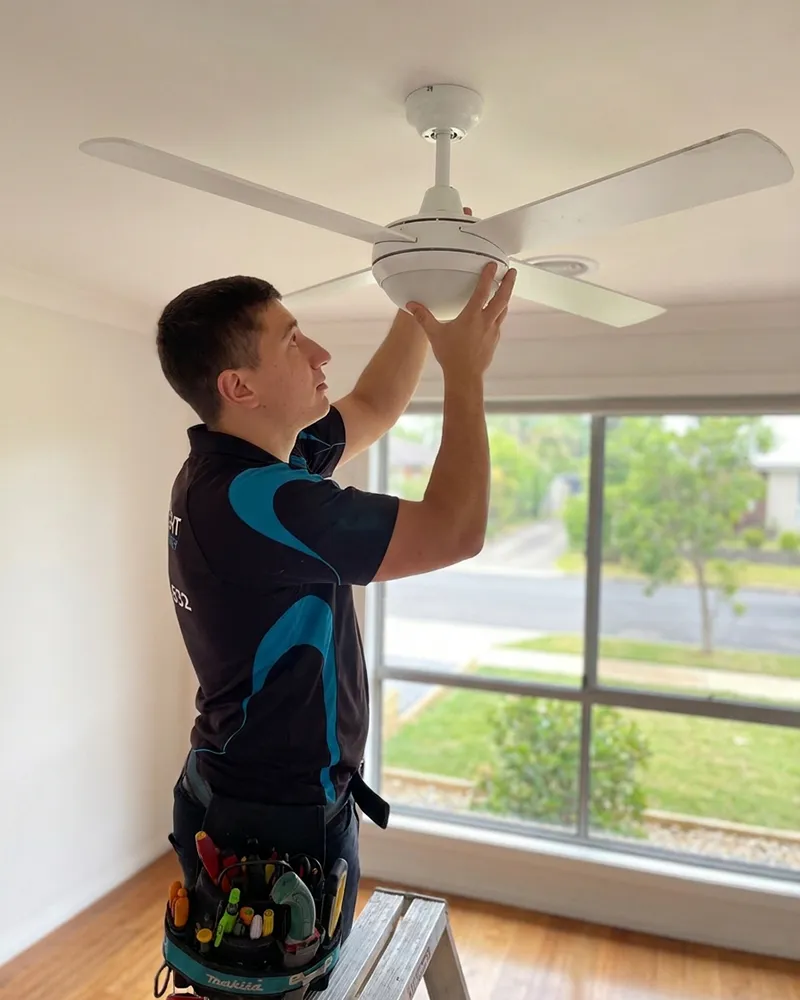
Our ceiling fan services
How much does ceiling fan installation cost in Sydney?
Here’s a guide to typical ceiling fan installation prices. Every home is different, so we come out and quote on site before any work begins. That way, your price covers the fan you’ve chosen, your ceiling height, what the fan is being mounted to and any wiring needed. You’ll know exactly what you’re paying before we start.
| Service | Typical price |
|---|---|
| Supply, assembly and installation | $450 to $700 |
| Installation only (you supply the fan) | $300 to $500 |
| Timber support or bracing, new fan points, high ceilings and commercial fans | Quoted on site |
Prices are for a standard installation without a timber support.
What affects the final price
- Mounting and bracing. If the ceiling has no suitable joist where the fan needs to go, we fit a timber support to carry the fan’s weight and movement. This is quoted on site.
- Whether a fan point already exists. Converting a light point or adding a new point takes more time and materials than a straight swap.
- Wiring. New cabling, a wall controller or an upgrade to the circuit can all change the price.
- Roof space access. Tight, low or heavily insulated roof spaces take longer to work in. We install fans where there is roof space access above the ceiling, so we’re unable to install into concrete slab ceilings.
- Older homes. In houses built before 1990, we check the ceiling lining before cutting a new fan point, as older linings can contain asbestos.
- Ceiling height and pitch. High and raked ceilings may need angled mounts, downrods or extra access equipment.
- Fan type. Premium, oversized and smart fans cost more to supply and can take longer to assemble and balance.
- Safety switch protection. If the lighting circuit isn’t protected by an RCD, we’ll recommend adding one so the installation meets current requirements.
Choosing the right ceiling fan
What size ceiling fan do I need?
| Room | Blade sweep |
|---|---|
| Small rooms such as studies and smaller bedrooms | 900mm (36 inch) |
| Most bedrooms and medium living areas | 1200mm (48 inch) |
| Large bedrooms and living areas | 1320mm (52 inch) |
| Large open-plan living areas | 1400mm (56 inch) or more, or two fans |
What’s the best ceiling fan for a bedroom?
For most bedrooms up to about 4m x 4m, a 1200mm (48 inch) DC fan is the best fit. DC motors are the quietest type of ceiling fan, which matters when a fan runs all night.
A 52 inch (1320mm) fan suits only larger master bedrooms. In a standard bedroom, an oversized fan creates a strong draught even on low speed and can crowd the room visually.
If your ceiling is under 2.4m, choose a low profile (hugger) fan, which mounts close to the ceiling to keep safe blade clearance.
AC or DC motor
- AC fans cost less up front.
- DC fans are quieter and more energy efficient, and usually come with more speed settings and a remote.
If you’ll run the fan for long periods, DC is usually worth it.
Blades, finish and lighting
- Timber-look blades suit traditional homes.
- Matte black, white and brushed metal finishes suit modern interiors.
Decide early whether you want a built-in light, because this affects how the fan is wired and switched.
Indoor or outdoor rated
Any fan installed outside, including under a covered patio, should be rated for outdoor use.
Which ceiling fan brands do we recommend?
We supply and install fans from leading brands. Each suits a different need:
- Mercator: good value AC and DC fans, with plenty of options that include a light.
- Hunter Pacific: quiet DC fans with long motor warranties, a strong choice for bedrooms.
- Fanco: Australian-designed DC fans with smart control options.
- Beacon Lighting (Lucci Air): a wide range of styles. As a Beacon Preferred Electrician, we’re familiar with the full range.
- Ventair and Martec: reliable outdoor and coastal-rated models.
Already chosen your fan? We’ll install any brand.
What does a ceiling fan cost to run?
According to the NSW Government, a ceiling fan costs as little as 1 to 3 cents an hour to run. That’s roughly $7 to $22 for a whole summer of running it 8 hours a day.
DC motor fans are the cheapest to run. The NSW Government rates them as 70% more efficient than AC motor fans.
Fans also take the load off your air conditioner:
- NSW Government figures show that pairing fans with only occasional air conditioning can cut energy use by up to 76% compared with running an air conditioner alone.
- University of Sydney research found fans use 30 to 50 times less energy than air conditioning.
Ceiling fan placement and safety
Correct placement makes a fan work better and keeps it safe:
- Height: fan blades must sit at least 2.1 metres above the floor.
- Clearance: blades need good clearance from walls, cupboards and sloping ceilings so air can circulate.
- Downlights: keep fans out of the line of downlights where possible to avoid strobing.
- Fans with lights are best centred in the room for even airflow and light.
We’ll talk you through the best position for your room before we start.
Do you need a licensed electrician to install a ceiling fan in NSW?
Yes. In NSW, installing or connecting a ceiling fan is electrical wiring work and must be carried out by a licensed electrician. Moonlight Electrical holds NSW Electrical Contractor Licence 373818C.
When we finish the job, we test the installation and issue a Certificate of Compliance for Electrical Work (CCEW). This is your record that the work meets the AS/NZS 3000 Wiring Rules.
We’re also Level 2 ASP accredited. If we find your older switchboard needs attention while installing your fan, we can quote and carry out a switchboard upgrade or safety switch installation ourselves, with no need to bring in another contractor.
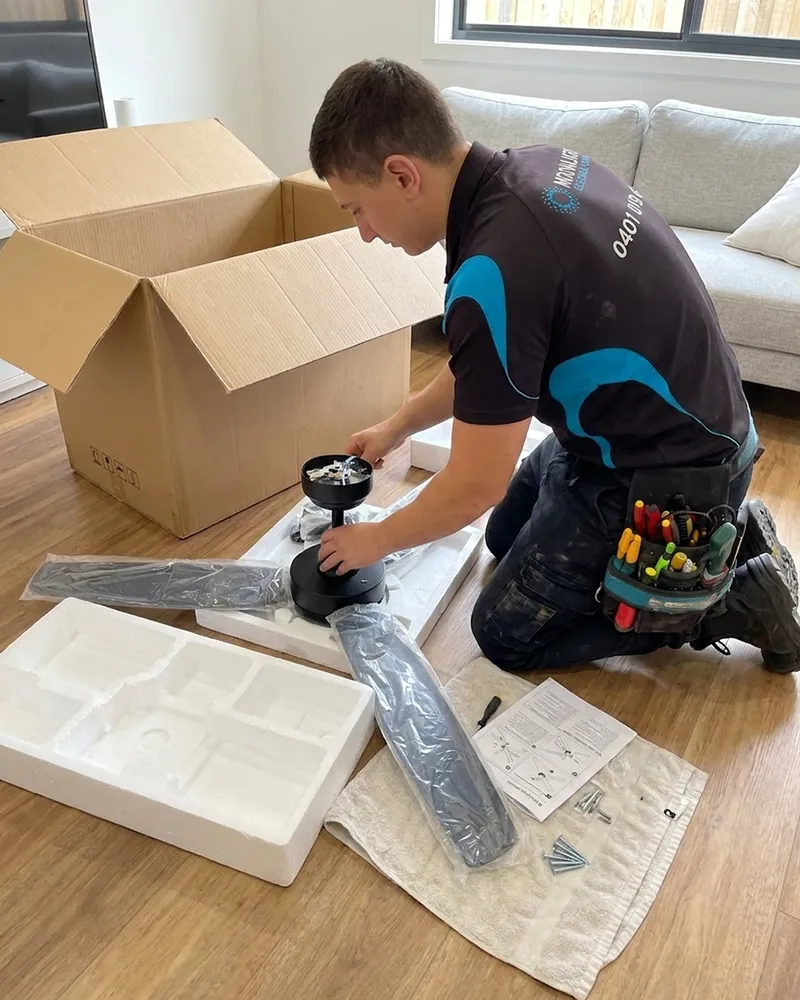
5-star service you can trust
Why our customers choose us…


Keep cool in summer and warmer in winter
In summer, run your fan anticlockwise (looking up at it). The airflow creates a wind-chill effect on your skin, so the room feels cooler without changing the air temperature. If you have air conditioning, the fan lets you set the thermostat a few degrees higher, so the system works less. Cutting air conditioning use is one of the most effective ways to save on electricity.
In winter, switch the fan to clockwise on a low speed. This gently pushes warm air trapped near the ceiling back down into the room, so your heater doesn’t have to work as hard.
20+
Years of experience
1hr
Emergency Response Time
24/7
Every day of the year
100%
Satisfaction Guarantee



Frequently Asked Questions
Is a 52 inch ceiling fan too big for a bedroom?
For most bedrooms, yes. A 52 inch (1320mm) fan suits larger master bedrooms. In a standard bedroom up to about 4m x 4m, a 48 inch (1200mm) fan gives enough airflow without a strong draught.
What is the quietest type of ceiling fan?
DC motor fans are the quietest type. They run almost silently on low speeds, which makes them the best choice for bedrooms and nurseries.
Are there rebates for ceiling fans in NSW?
There’s currently no NSW Government rebate for ceiling fans. However, ceiling fans are an eligible upgrade under the NSW Home Energy Saver program. It offers eligible homeowners and landlords zero-interest loans of up to $15,000 through approved finance providers.
Should I put ceiling fans in a new home?
They’re worth planning in from the start. The NSW Government’s example designs for meeting the higher BASIX standards include ceiling fans in the living room for both Western and Eastern Sydney. Wiring fan points during the build is also far simpler than adding them later.
Can you install ceiling fans in concrete ceilings?
No. We install ceiling fans where there is roof space access above the ceiling. We don’t install fans into concrete slab ceilings.
Why do my lights flicker when the ceiling fan is on?
This is usually strobing. It happens when the fan blades pass under downlights or another light source. Positioning fans away from downlights, or moving a light, usually fixes it. We’ll plan around this when installing your fan.