

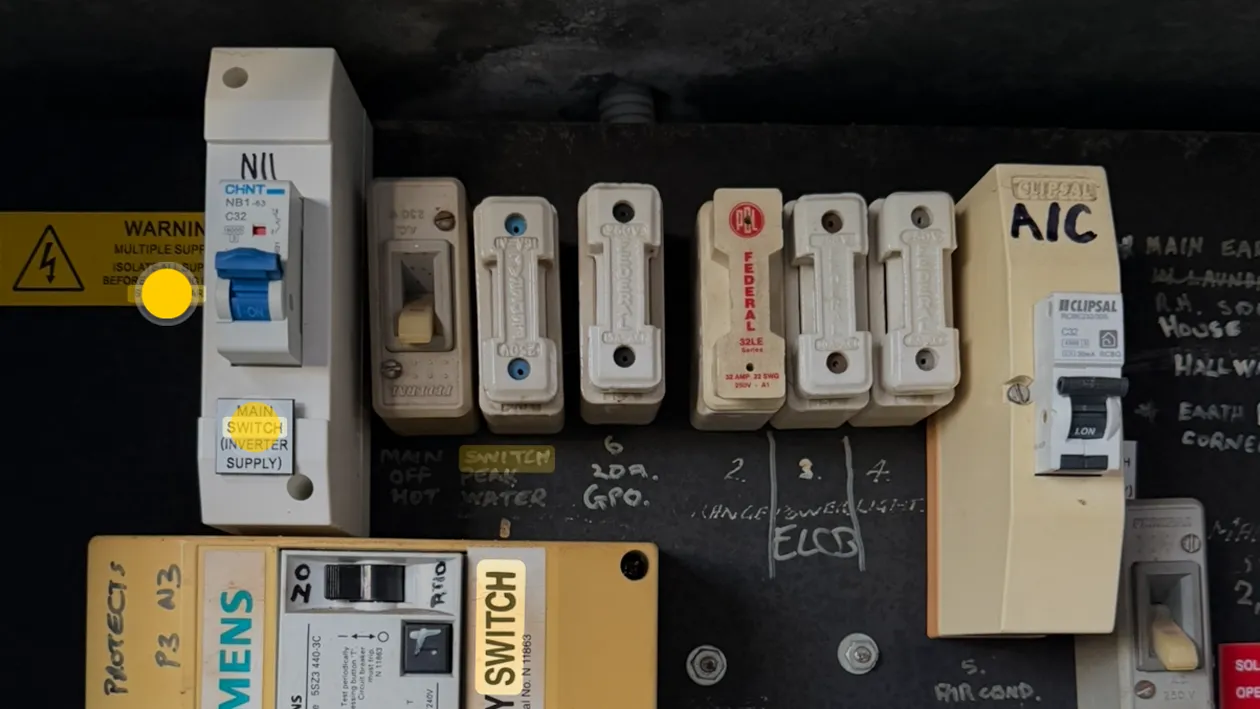
Ceramic fuses are legal and they are not defective. But if the ceramic fuses in question are sitting in an old rewirable fuse board on the side of your house, that board is doing half the job a modern switchboard does. It protects your wiring. It does nothing to protect you.
That is the distinction worth getting straight before anything else:
- Ceramic cartridge fuses inside appliances, power tools and microwaves are the correct part. Nothing has replaced them. Leave them alone.
- Ceramic rewirable fuse boards in older switchboards are the ones that have been superseded, and for good reason.
Most people searching for this are dealing with one or the other. This covers both, starting with the one that matters more.
The Problem With a Ceramic Fuse Board
A fuse is a deliberate weak link. Too much current flows, the wire inside melts, the circuit dies. That is genuinely clever engineering and it has protected houses for a century.
The trouble is what it does not do.
A fuse protects your cable, not your body
This is the big one. A fuse blows when the current is high enough to threaten the wiring. The current needed to stop a heart is a small fraction of that. Someone can be electrocuted on a circuit while the fuse sits there, perfectly intact, doing exactly what it was designed to do.
A safety switch (an RCD) is the device that watches for current leaking to earth through a person and cuts the power in a fraction of a second. A fuse board with no RCDs has no equivalent.
The national electrical regulators’ fatality data puts the risk where it actually sits. Over the 24 years to mid-2024, consumer installations and equipment, meaning the wiring and appliances inside homes and workplaces, were involved in 299 deaths across Australia and New Zealand. That is close to double the 157 linked to the electricity supply network itself. NSW alone has recorded 117 electrical fatalities since July 2000, more than any other state (ERAC, Electrical Fatal Incident Data 2023-24).
The danger is behind your own walls. Not out on the poles.
Rewirable fuses get rewired by hand
A ceramic rewirable fuse carrier is repaired by threading a new piece of fuse wire across two terminals. Which means the protection on that circuit is only as good as whatever wire the last person had in the drawer.
We have pulled apart boards wired with the wrong gauge, with two strands twisted together to stop the “annoying” blowing, and on one occasion with a nail. Every one of those circuits was unprotected. The owner had no idea. A fuse that never blows looks identical to a fuse that works.
A circuit breaker cannot be defeated this way. It trips or it does not.
There is a second problem behind the carriers on pre-1990 boards. Some fuse carriers are lined with woven asbestos textile, and the panel the board is mounted on is often asbestos resin. Our guide to identifying an asbestos switchboard explains what to look for without opening anything.
You cannot tell a blown ceramic fuse by looking at it
Ceramic bodies are opaque. There is no visible filament, no scorch mark, no obvious tell. Diagnosing a fault on a fuse board means pulling carriers out one at a time and testing them. A breaker board shows you the tripped circuit at a glance.
Old boards run out of room
Ceramic fuse boards were sized for the loads of their era. A house with an induction cooktop, ducted air conditioning, a heat pump hot water system and an EV charger is asking a great deal more of the same board. Very often there is simply no physical space for the additional circuits, and no capacity to carry them if there were. Our guide to electrical load capacity explains how quickly modern homes outgrow their original design.
This is what usually forces the issue. Someone books an EV charger installation, we look at the board, and the conversation changes.
What Replaces a Ceramic Fuse Board
A modern switchboard does two jobs where the old one did one. It still protects the cable, and it also protects the person.
Three devices do the work.
| Device | What it protects against | What it replaces |
|---|---|---|
| Circuit breaker (MCB) | Overload and short circuit. Protects the wiring. | The fuse. Resets with a switch instead of being rewired. |
| Safety switch (RCD) | Earth leakage. Protects people from electric shock. | Nothing. A fuse board has no equivalent at all. |
| RCBO | Both of the above, on a single circuit. | Both, and isolates the fault to one circuit instead of the whole board. |
The RCBO is the one worth asking about. On a board with shared RCDs, one faulty appliance can knock out half the house. With RCBOs, only the circuit at fault drops out and everything else stays on. It costs more up front and homeowners rarely know to ask for it.
What an upgrade actually involves
Upgrading rarely means rewiring the house. In most cases, we replace the old fuse board with a modern enclosure, fit breakers and RCD protection, test every circuit and issue a Certificate of Compliance for Electrical Work. The existing wiring stays where it is, provided the cable is sound.
If the house still has old rubber-insulated or VIR cable, that is a different conversation, and one worth having honestly. A new board on perished wiring is a new board on perished wiring. We will tell you which situation you are in rather than quietly upselling you into a full rewire you may not need.
Our switchboard upgrade page covers the process in detail, and the safety switch installation page explains RCDs on their own if that is all you need.
So Why Is My Old Fuse Board Still Legal?
Because nobody has made you change it. That is the entire answer, and there is a specific mechanism behind it.
Under AS/NZS 3000, work on an existing installation is either a repair or an alteration. A repair carries no obligation to bring anything up to current standards. An alteration does. The national electrical regulators clarified this in their advisory note on Clause 2.6.3.2.5, confirming that replacing an item with an equivalent item in exactly the same location, without altering the sub-circuit, is treated as a repair with no RCD requirement attached (ERAC, Alterations and RCDs, 2022).
Swap a blown fuse for an identical one and nothing is triggered. The board stays legal indefinitely.
It just never gets any safer.
The same advisory sets out what happens when you do move. Once a switchboard is replaced for any reason, every applicable final sub-circuit coming off that board must have RCD protection fitted. There is no partial version. Replace the board and the whole installation comes up to standard with it, which is the strongest argument for doing it properly the first time.
How to Tell if a Ceramic Fuse Has Blown
If you are dealing with a ceramic cartridge fuse out of an appliance, this part is for you. If the fuse is in your switchboard, stop here and call a licensed electrician. Switchboard work is not a DIY job in NSW.
Because the body is opaque, the only reliable method is testing for continuity. Remove the fuse from the appliance first. Never test one sitting in a live circuit.
Method 1: The multimeter test
- Set the multimeter to continuity (the sound wave icon) or Ohms (Ω).
- Touch the red probe to one metal end cap.
- Touch the black probe to the opposite end cap.
Reading it: a continuous beep, or a reading close to 0.00, means the fuse is good. No beep, or an “OL” (open loop) reading, means it has blown.
Method 2: The torch trick
No multimeter? A standard torch will do.
- Take the batteries out.
- Drop the fuse into the battery tube, then load the batteries in behind it so everything makes metal-to-metal contact.
- Switch the torch on.
Reading it: if the torch lights, current is passing through and the fuse is good. If it stays dark, the fuse has blown.
The most common mistake
Testing the fuse while it is still in the circuit. The rest of the circuit gives the current another path and the reading means nothing. Take the fuse out. Every time.
And if the replacement blows straight away, the fuse was never the problem. Something on that circuit is drawing more than it should. Our guide on what causes a blown fuse runs through the usual culprits.
Choosing the Right Replacement Cartridge Fuse
Match the physical size, the voltage and the amperage exactly.
You can safely replace a glass fuse with a ceramic fuse of the same rating. Do not go the other way. If an appliance was designed with a ceramic fuse, especially something that runs hot like a microwave, a glass one is not an equivalent part.
| Glass fuse | Ceramic fuse | |
|---|---|---|
| Body | Transparent | Opaque, sand-filled |
| Breaking capacity | Low | High |
| Under high heat | Can shatter | Contains the fault |
| Best suited to | Automotive, low-current electronics | Microwaves, high-heat appliances, industrial tools |
Fast-acting or time-delay?
Time-delay (slow blow) fuses tolerate a brief inrush of current at start-up. They suit motors, compressors and microwaves, which draw a spike when they kick on.
Fast-acting fuses break the circuit almost immediately. They suit sensitive electronics such as computer boards, where even a short overcurrent does damage.
The appliance was designed around one or the other. Use what the manufacturer specified. Ceramic fuses have no polarity, so they can go in either way around.
Never fit a higher-rated fuse
This is the one that starts fires. A 20-amp fuse in a slot designed for 15 will happily let 20 amps flow through wiring rated for 15. The fuse does its job. The wiring melts.
What Is Actually Inside a Ceramic Fuse?
A metal filament running through a tube of silica sand, sealed inside a ceramic body with a metal cap at each end. Under normal load, current passes straight through. Push too much through and the filament melts.
The sand is the whole point. When the filament melts it creates an electrical arc, and that arc is hot enough to keep current flowing across the gap. In a glass fuse that arc has nowhere to go, which is why glass fuses can crack or shatter under a heavy fault. In a ceramic fuse, the silica sand absorbs and quenches it.
That is what gives ceramic fuses their much higher breaking capacity, and it is exactly why your microwave uses one. The component is sound. It is the board it lives in that has moved on.
When to Call an Electrician
Testing a cartridge fuse out of an appliance is fine. Anything at the switchboard is not. In NSW, electrical wiring work must be carried out by a licensed electrician. That includes rewiring a fuse carrier in your switchboard. The narrow exemptions cover things like changing a light bulb or a plug-in fuse, not working inside the board.
Call us if:
- Your switchboard still uses ceramic rewirable fuses with no safety switches
- A fuse or breaker keeps blowing or tripping
- You can smell burning, see scorch marks, or the board is warm to touch
- You are adding an EV charger, induction cooktop, air conditioning or any significant new load
- You are buying an older home and want to know what you are inheriting
Moonlight Electrical is a family-owned and operated business, Level 2 ASP accredited, and available 24/7 across Western Sydney and greater Sydney. We quote per job, not per hour, so you know the cost before we start. Book before midday and we will be there within 60 minutes or the service call is free. All workmanship is backed by our Lifetime Labour Guarantee, and we offer a 10% seniors discount.
Call 0401 019 632 and we will tell you honestly what your board needs.