

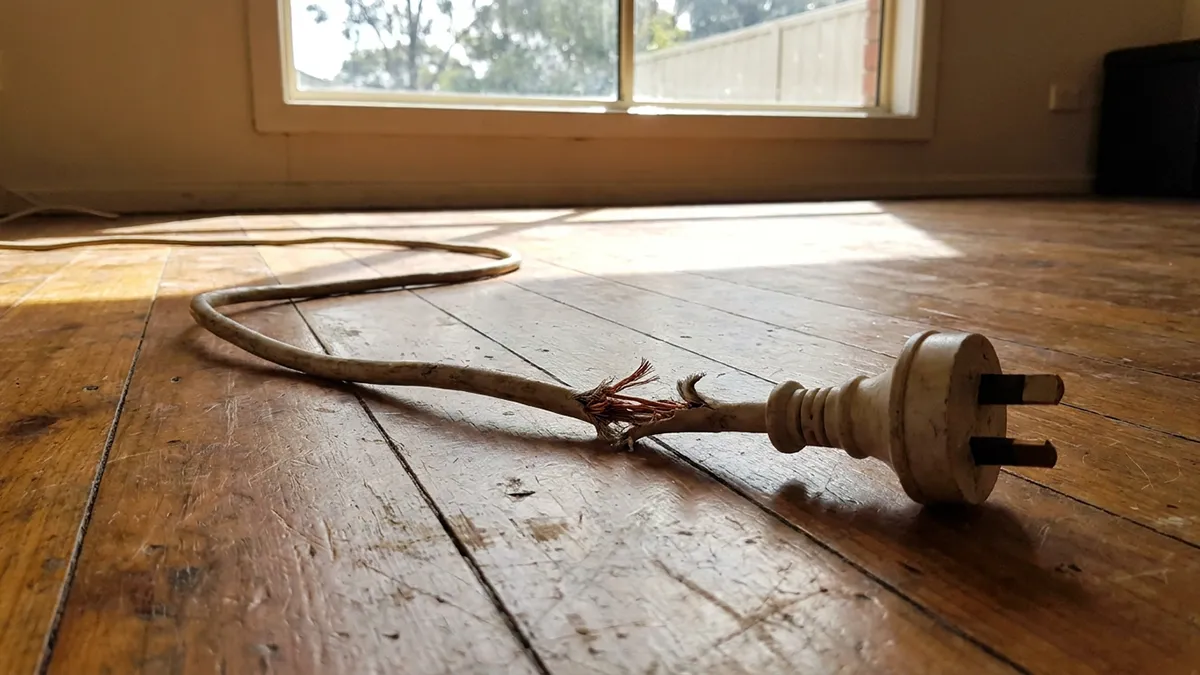
A frayed wire is a cable or cord whose outer insulation has worn, cracked or split, exposing the inner wires or bare copper. It can happen to a phone charger, an appliance cord or the wiring inside your walls, and the risk depends on which one it is.
A frayed cord is easy to ignore. The phone charger still works, the lamp still turns on, and the damage looks minor. But a frayed cord can be a real fire and shock risk, depending on what type of cord it is and how deep the damage goes.
This guide covers how to check a damaged cord in 10 seconds, which repairs are safe, a step-by-step fix for low-voltage cables, and why mains-powered cords should always be replaced or handled by a licensed electrician.
What Should You Do If You Find a Frayed Electrical Cord?
Unplug it at the wall straight away, then check how deep the damage goes. Chargers with minor damage can be repaired; mains cords with exposed wiring should be replaced.
The 10-Second Safety Triage
Before you do anything else, look closely at the damaged section and work out which level of damage you’re dealing with.
Level 1: Surface nick (a nicked outer jacket)
Only the outer rubber or plastic jacket is scratched or scuffed. The coloured inner wires are fully covered and intact. A nicked jacket isn’t immediately dangerous, but it’s a weak point that will keep wearing.
Action: Safe to reinforce.
Level 2: Exposed inner insulation
The outer jacket is torn and you can see the coloured inner wires, but their insulation is still intact.
Action: Safe to repair on extra-low voltage cables like phone chargers and USB leads. Replace it if it’s a mains-powered (240V) cord.
Level 3: Exposed copper or metal
You can see bare metal wire strands.
Action: Danger. Unplug it immediately. Do not attempt a DIY repair on any mains-powered cord.
Your Immediate Action Plan
- Switch off and unplug the device. Turn the power off at the wall first, then pull the plug out by the plug head. Never pull on the cord itself, and especially not near the frayed section.
- Work out what type of cord it is. Is it an extra-low voltage cable (phone charger lead, USB cable, laptop charger cable on the device side of the power brick) or a mains-voltage cord that plugs straight into a 240V powerpoint (lamp, kettle, heater, extension lead)?
That second question decides everything that follows.
In this guide, “mains voltage” means anything that plugs straight into a 240V powerpoint. “Extra-low voltage” means chargers and USB cables.
Useful tools: A non-contact voltage tester lets you confirm a cord isn’t live before handling it. A multimeter is handy for low-voltage cables. You don’t need one for the repairs below.
Can Frayed Wires Be Fixed?
Quick answer: Yes, frayed extra-low voltage cables like phone chargers can be fixed with liquid electrical tape or heat shrink tubing. Mains-voltage cords are different. Replace the appliance or have an electrician replace the cord. Never use super glue or hot glue on a frayed wire.
Repair Methods Compared
| Method | Rating | Why |
|---|---|---|
| Super glue or hot glue | Avoid | Flammable, goes brittle, and doesn’t provide proper electrical insulation |
| Vinyl electrical tape | Temporary only | Fine as a short-term fix on low-voltage cables, but it loosens over time and leaves sticky residue |
| Liquid electrical tape | Excellent | Forms a flexible, waterproof insulating coating that moulds around the damage |
| Heat shrink tubing | Best | Gives permanent insulation plus structural support at the weak point |
For phone chargers and USB cables, use heat shrink. For small nicks in the outer jacket, liquid electrical tape does the job.
Fix or Replace? A Simple Decision Path
- Does the cord plug straight into a 240V powerpoint?
Yes: Replace the cord or the appliance. Don’t DIY it. - No, it’s an extra-low voltage cable (charger, USB). Are bare copper strands visible or touching each other?
Yes: Replace the cable.
No: Go ahead with the DIY fix below.
Why the line is drawn at mains power: In NSW, electrical work on 240V equipment should be done by a licensed electrician. Tape and heat shrink aren’t approved fixes for a mains cord. If the repair fails, you’re looking at a shock or a fire. Replacement cords are cheap compared to what’s at stake.
This isn’t just our advice. South Australia’s Metropolitan Fire Service recommends having a qualified repairer replace any frayed, cracked, scorched or damaged cord or extension lead, or throwing out the appliance altogether.
How to Fix a Frayed Wire Cable (Step-by-Step Low-Voltage Repair)
Direct answer: The best way to permanently fix a frayed low-voltage cable is to coat the damaged area with liquid electrical tape, let it cure, then reinforce the section with heat shrink tubing.
The 5-Minute Cable Saver Method
(Plus drying time for the liquid tape.)
Step 1: Disconnect the power
Unplug the cable at both ends. Make sure it isn’t connected to a charger, device or power source.
Step 2: Clean the area
Wipe the frayed section with isopropyl alcohol to remove grease and grime. Let it dry completely.
Step 3: Apply liquid insulation
Brush a thin layer of liquid electrical tape over the damaged section, extending a little past the damage on both sides. Leave it to dry for about 10 minutes, or as long as the product label recommends. A second thin coat is better than one thick one.
Step 4: Slide on the heat shrink
Cut a piece of adhesive-lined heat shrink tubing (3:1 shrink ratio works well) that covers the damage with a centimetre or two spare on each side. Slide it over the repaired section.
Tip: if the cable has plugs on both ends that are wider than the tubing, you’ll need split heat shrink or a wider tube. Check before you start.
Step 5: Apply heat
Use a heat gun on a low setting, moving it evenly around the tubing until it shrinks tight and a small bead of adhesive appears at each end. A hair dryer on high can work for thin tubing, but it often won’t get hot enough to activate adhesive-lined heat shrink properly. A heat gun is the safer bet.
Try This Now: No Heat Shrink or Liquid Tape on Hand?
Wrap the damaged section tightly with good-quality vinyl electrical tape. Stretch it slightly as you wrap so it seals firmly, overlap each turn by about half, and extend the wrap around 2.5cm past the damage on each side. It’s a stopgap, not a fix.
Is it safe to keep using a frayed cord until you replace it? Not if it’s a mains cord. Stop using it today.
Common Mistakes to Avoid
- Using sticky tape, masking tape or duct tape. None of these are insulators and some are a fire hazard.
- Working on a cable that’s still plugged in.
- Using super glue or hot glue.
- Taping up a mains-voltage cord and continuing to use it.
Check Your Repair
Gently bend the repaired section back and forth. If you can see the inner wires, or the tape or tubing slides around, the repair has failed. Redo it or replace the cable. Keep an eye on it over the following weeks too, and replace the cable if it gets warm during use.
Can a Frayed Wire Start a Fire?
Yes. When insulation breaks down, electricity can arc (jump) between exposed conductors or to nearby metal. Arcing produces intense, concentrated heat in a fraction of a second, easily enough to ignite dust, carpet, curtains or bedding nearby.
It happens more than you’d think. A 2024 peer-reviewed study of fire service records in Merseyside, England, found faulty wiring, cables and plugs caused 57.8% of household electrical fire injuries between 2011 and 2022. More than a third of those injuries (36.7%) happened between 10pm and 6am, when people are asleep and slow to notice smoke. The same study found only 15.6% of electrical fire injuries were due to householder carelessness, so most of these fires came from faults, not from people misusing their appliances.
Damage isn’t always visible. A cord that’s been crushed under furniture, run under a rug or kinked repeatedly can overheat long before it looks frayed.
Key takeaway: A frayed mains cord is never “just a little spark”. It’s a potential ignition source and a shock hazard every time it’s plugged in.
Safety switches (RCDs) help here. A working safety switch can cut power in as little as 30 milliseconds if current leaks to earth, which can prevent a fatal shock. If your home doesn’t have safety switches on all circuits, it’s worth having them installed.
Can a Frayed Wire Electrocute You?
Yes. Touching exposed copper on a 240V cord can send current through your body, causing burns, heart rhythm problems or death. Children and pets are most at risk because they’re more likely to grab or chew a damaged cord.
What Causes a Wire to Fray?
- Pulling the cord instead of the plug. This strains the point where the cord enters the plug, which is where we see fraying most often.
- Pinching and crushing. Cords trapped under furniture legs, doors or heavy rugs get damaged internally.
- Cords under rugs. Fire services warn that a covered cord can’t shed heat when it’s drawing a high load, and the rug can hide any wear developing underneath.
- Repeated bending. Chargers bent sharply at the device end wear through over time.
- Age and heat. Older cords go brittle, especially near heat sources like heaters and toasters.
- Pets. Dogs, cats and rabbits will happily chew through a cord.
- Rats, mice and possums. In Sydney roof spaces, rodents can chew through cables and leave hidden frayed wiring you won’t see until something goes wrong.
Which Appliances Should You Unplug Every Night?
With so many electrical fire injuries happening overnight, switching off and unplugging high-risk appliances before bed is one of the simplest ways to reduce your risk. Start with:
- Portable heaters
- Toasters, kettles and sandwich presses
- Hair straighteners and curling wands
- Any appliance with known cord damage (until it’s replaced)
Running a business? Your portable equipment should be tested and tagged regularly to AS/NZS 3760. It catches damaged cords early.
When to Call an Electrician
Signs of Frayed Wiring Inside Your Walls
You often can’t see damaged wiring, but you can notice its effects: lights that flicker or dim, a buzzing or crackling sound from a powerpoint or switch, a burning plastic smell, or a powerpoint that feels warm.
Call a licensed electrician if:
- A mains cord or extension lead has exposed wiring
- You find frayed or damaged wiring in your walls, ceiling or roof space
- A powerpoint is scorched, discoloured, warm or makes a buzzing or crackling sound
- Your lights flicker or dim for no obvious reason
- Your safety switch keeps tripping when a particular appliance is plugged in
- You smell burning plastic near a cord or powerpoint
Wiring in your walls is a different story. Damaged wiring inside the walls is fixed wiring and must only ever be repaired by a licensed electrician. In older homes, deteriorating rubber-insulated (VIR cable) is a common culprit and may point to a broader rewiring job.
Need Help With Damaged Wiring in Sydney?
Moonlight Electrical is a family-owned and operated electrician servicing Merrylands, Parramatta and the wider Sydney area, with a 5.0 Google rating. Day or night, we’ll come to you. Book before midday and we’ll arrive within 60 minutes, or the service call is free.
We quote per job, not per hour. You’ll know the cost before we start. All our work is backed by our Lifetime Labour Guarantee and a 7-year warranty, and seniors get 10% off.
Call us on 0401 019 632 for fast, safe help with damaged cords, faulty powerpoints or wiring concerns.