

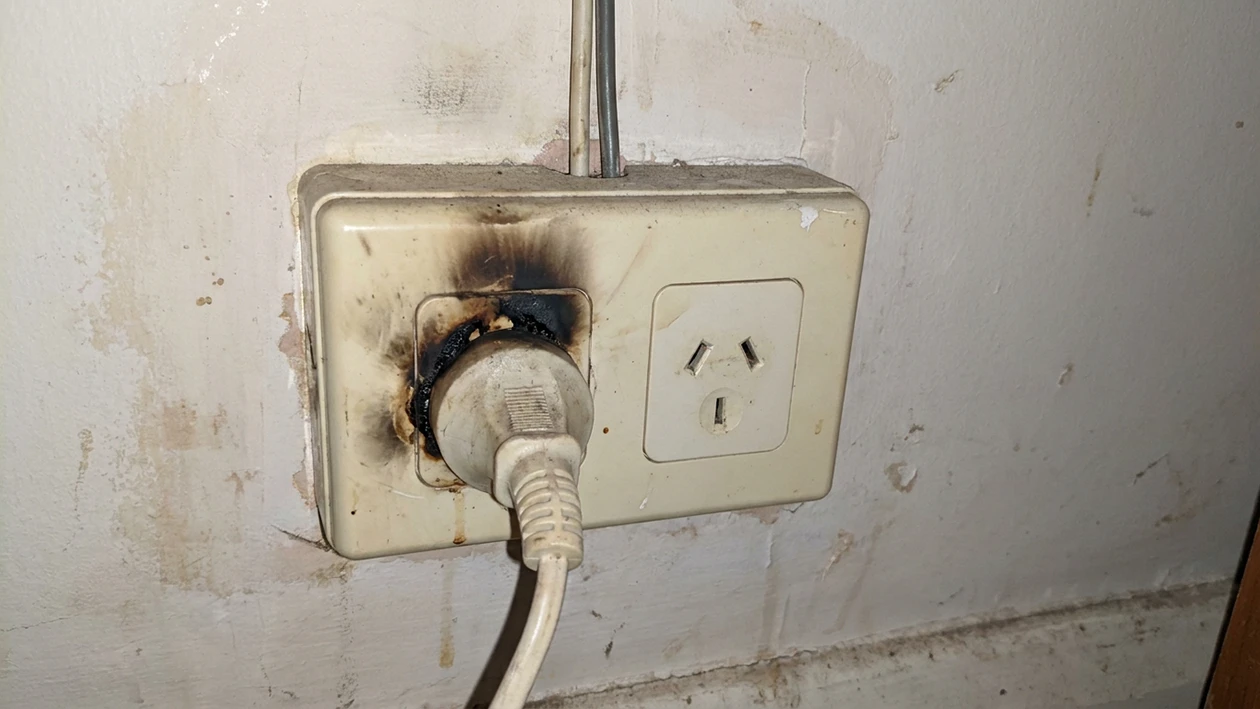
An electrical burning smell is a warning sign of overheating wiring, an overloaded circuit or a failing component, and it needs urgent attention. If you can see smoke, flames or sparking, get everyone out of the house and call 000. If you can only smell it, switch off the power at the main switch and call an emergency electrician straight away.
Here’s exactly what to do, step by step.
Should I call 000 if I smell electrical burning?
Only if you can see smoke, flames, active sparking or a fire. In that case, get everyone out and call 000 for the fire brigade. A burning smell on its own is still urgent, but it’s a job for an electrician rather than the fire brigade. Cut the power, keep everyone away from the area and get a licensed electrician out as soon as possible. Electrical faults can overheat inside walls and ceilings where you can’t see them, so don’t wait to see if the smell goes away.
What to do if you smell electrical burning, step by step
Step 1: Turn off the power at the main switch. Go to your switchboard and turn the main switch to OFF. This stops power flowing to whatever is overheating. Don’t touch the switchboard if it’s hot, smoking or sparking.
Step 2: Switch off and unplug anything near the smell. If the smell seems to be coming from an appliance, switch it off at the powerpoint and pull the plug out by the plug body, not the cord. If a plug, cord or powerpoint is too hot to touch, leave it alone. The main switch being off is enough.
Step 3: Keep everyone away and air the room out. Keep people and pets out of the affected area and open windows and doors to clear the fumes.
Step 4: Call an emergency electrician. Tell them what you can smell, where it’s strongest and what was running at the time. Leave the main switch off until they’ve found and fixed the fault. Don’t turn it back on to “see if it happens again.”
If you see smoke, flames or sparking
Get everyone out of the house straight away and call 000. Don’t stop to collect belongings, never throw water on an electrical fire, and don’t try to fight it yourself. Only turn off the main switch on your way out if you can reach it without going near smoke or flames. You should also get out and call 000 if the smell keeps getting stronger after the power is off, or if you can feel heat coming from a wall or ceiling, since both can mean something is smouldering out of sight. Once the fire brigade has cleared the home, call an electrician before the power goes back on.
Why do I keep smelling electrical burning?
A burning smell that comes and goes usually means a connection is heating up under load, then cooling down when the load drops. Note when it happens, such as when the heater, oven or dryer is on, and tell your electrician. It narrows down the circuit quickly.
Common mistake: The smell stopping doesn’t mean it’s fixed. A loose or damaged connection can cool down and heat up again every time the circuit is used. A smell that comes and goes still needs an electrician.
What does an electrical fire smell like?
An electrical fire smell is usually sharp and acrid, like hot or melting plastic. Some people notice a fishy smell instead, which can come from overheating plastic fittings and components. A hot, metallic smell can point to arcing at a loose connection. Whichever you notice, treat it as a fault and switch off the power.
Why do I smell electrical burning when nothing is burning?
A burning smell with no obvious source usually means one of two things. Either there’s a hidden fault in a wall, ceiling or appliance, or you’re experiencing phantosmia. That’s the medical name for smelling something that isn’t there.
This quick check will help you work out which one it is.
Self-assessment checklist
Checklist A: Signs the smell is coming from your home
- Someone else in the house can smell it too
- Pets are acting unsettled or avoiding a particular room
- The smell is stronger near a powerpoint, switch, light fitting, the switchboard or a large appliance
- The smell goes away when you step outside and comes back when you return
- Lights have been flickering, or a circuit breaker or safety switch has been tripping
Checklist B: Signs the smell may be coming from you
- Nobody else can smell it
- The smell follows you outside, into the car or to other buildings
- You’ve recently had a cold, sinus infection or COVID-19
- You get migraines, or you’ve had a recent head injury
What your answers mean
If anything in Checklist A applies: Treat it as an electrical fault. Turn off the power at the main switch and call an electrician. This is true even if nothing is plugged in. Wiring inside walls can overheat at a loose terminal or a damaged section of cable whether or not an appliance is running.
If Checklist B applies and Checklist A doesn’t: The smell is more likely to be phantosmia. Still, get a second person to walk through the house to rule out a real fault.
What illness causes you to smell burning?
Smelling burning when nothing is there is more common than most people realise. A large US health survey asked more than 7,400 adults aged 40 and over whether they ever smelled a burning odour when nothing was there. About 1 in 15 said yes. It was more common in people who’d had a head injury or who reported dry mouth.
Phantosmia is often described as a burning, smoky or chemical smell. Common causes include sinus infections, colds and other respiratory infections (including COVID-19), migraines and head injuries. Less commonly, it can be linked to neurological conditions such as epilepsy, and in rare cases a brain tumour. Some causes are minor, some aren’t.
What to do: If the smell follows you away from home or keeps returning over several days, book in with your GP. They can assess you and refer you to an ear, nose and throat specialist or a neurologist if needed.
What causes an electrical burning smell?
An electrical burning smell means something is overheating. Here are the usual culprits:
- A loose connection at a powerpoint, switch or the switchboard
- An overloaded circuit or power board
- Ageing or damaged cable insulation
- A worn-out powerpoint or switch
- A failing appliance or cord
In older homes with ceramic fuses, an overheating fuse holder can give off the same smell. Our guide to blown fuses explains what to look for. A damaged cable can also cause a short circuit, which often leaves a scorched smell behind.
What are the early warning signs of an electrical fire?
The early warning signs of an electrical fire include a burning plastic or fishy smell, powerpoints or switches that feel warm or look discoloured, flickering or dimming lights, circuit breakers that trip repeatedly, and small shocks or tingles when you touch an appliance. Don’t ignore any of them. Get the circuit checked by an electrician.
Your safety devices won’t always catch this type of fault. A circuit breaker trips when a circuit draws too much current, and a safety switch trips when current leaks to earth. A loose connection can heat up and scorch the plastic around it without doing either. Sometimes your nose is the only warning.
Can an electrical fire start if nothing is plugged in?
Yes. The wiring inside your walls and ceiling carries power whether or not anything is plugged in. A loose terminal, damaged cable or rodent-chewed insulation can overheat on its own. This can happen in older homes with deteriorating cable, such as VIR cable, or where rodents have chewed wiring in the roof.
The 5-point home investigation
Only work through this with the main switch off and no smoke, flames or sparking anywhere in the house. If at any point you find heat, smoke or scorching, stop and leave the rest to your electrician. If you see smoke or flames, get out and call 000.
1. The touch test. Lightly rest the back of your hand on the plastic faceplates of powerpoints and light switches. Don’t touch any exposed metal, and don’t remove any covers. A faceplate that feels warm when nothing is plugged in is a fault.
2. The sniff test. Check near your switchboard, your meter box and the appliances that draw the most power, such as ovens and cooktops, clothes dryers, heaters, air conditioners and hot water systems. The smell is usually strongest close to the source.
3. The visual test. Look for brown, yellow or black scorch marks around powerpoint slots, switch plates, light fittings and plugs. Check for melted or warped plastic too.
4. The cord test. Pull furniture away from the walls and check extension leads, power boards and appliance cords for fraying, flattening, kinks or cords that have been pinched under furniture or run under rugs.
5. The unplugged test. If everything is unplugged and you can still smell burning, the fault is most likely in the fixed wiring, which only a licensed electrician can test and repair.
You’ve done your job if: You’ve found the affected area, turned off the power, and kept everyone away from it until an electrician arrives. You don’t need to find the exact fault yourself. That’s the electrician’s job.
Is the electrical burning smell toxic?
Yes. The smell comes from plastic insulation and other materials breaking down as they overheat. Burning PVC, which is widely used to insulate electrical cables, releases hydrogen chloride gas, and smouldering materials also produce carbon monoxide.
Key takeaway: Don’t hang around in the fumes. Breathing them in can cause headaches, nausea, dizziness, coughing and irritation to your eyes, nose and throat. Once the power is off, open windows and doors to air the room out. If anyone has trouble breathing or feels unwell, get them into fresh air and call 000 for medical help.
Which appliances need the most care, and what should you switch off?
Some appliances put more demand on your wiring or carry a higher risk if something goes wrong.
Don’t leave running while you’re out or asleep: portable heaters, clothes dryers and electric blankets. Clean the dryer lint filter every time you use it, and check electric blankets for wear before winter.
Switch off at the wall when not in use: toasters, air fryers, kettles, coffee machines and portable heaters.
Don’t leave charging unattended overnight: e-bike and e-scooter batteries, power tool batteries and damaged or non-genuine phone chargers. Charge them on a hard surface, away from anything flammable, and unplug them once they’re full.
It’s happening right here in Western Sydney. Fire and Rescue NSW recorded at least 318 lithium-ion battery fires across the state in 2024, almost double the 2022 figure. Canterbury-Bankstown, Cumberland and Blacktown were all among the five local government areas with the most battery fires between 2022 and early 2025. Fire and Rescue NSW’s advice is simple: never charge e-bike or e-scooter batteries overnight or while you’re asleep. If a battery or charger smells hot or chemical, switch it off at the wall and stop using it.
If you find yourself running a lot of power boards and double adaptors, it’s a sign your home needs more powerpoints. Our guide to electrical load capacity explains how to tell when a circuit is being pushed too hard.
How an electrician finds the source
We isolate circuits one at a time to find where the heat is coming from. Then we repair or replace the faulty connection, fitting or cable to AS/NZS 3000, and issue a Certificate of Compliance for notifiable work. The power stays off until it’s safe.
How to stop it happening again
Electrical burning smells usually trace back to a few fixable problems: loose connections, ageing wiring, overloaded circuits and old switchboards. Once the fault’s fixed, here’s how to stop it coming back:
- An electrical safety inspection checks your wiring, switchboard and fittings against the Australian wiring rules (AS/NZS 3000). Our electrical safety inspections are a good starting point if you’re in an older home.
- A switchboard upgrade replaces old ceramic fuses with modern circuit breakers and safety switches. See our switchboard upgrades page for the signs it’s time.
- Rewiring may be needed if the inspection finds perished insulation. Our house rewiring page covers full and partial rewires.
- Working smoke alarms are required by law in every NSW home, on every level. Photoelectric, interconnected alarms give everyone in the house the earliest possible warning. Find out more about smoke alarm installation.
If the smell is coming from your meter box or the point where power enters your property, that work falls outside what a standard electrician can do. As Level 2 ASP accredited electricians, we can repair faults on the cables that bring power from the street to your meter, as well as the wiring inside your home.
Smell burning? Call Moonlight Electrical 24/7
Moonlight Electrical is a family-owned and operated electrician servicing Sydney, with a 5.0 Google rating. Our emergency electricians are available 24 hours a day, 7 days a week.
Book before midday and we’ll arrive within 60 minutes, or the service call is free. We quote per job, not per hour, so you’ll know the cost before any work starts. All our work is backed by our Lifetime Labour Guarantee and a 7-year warranty, and seniors receive a 10% discount.
If you can see smoke, flames or sparking, get out and call 000 first. If it’s just the smell, switch off the power and call Moonlight Electrical on 0401 019 632.