

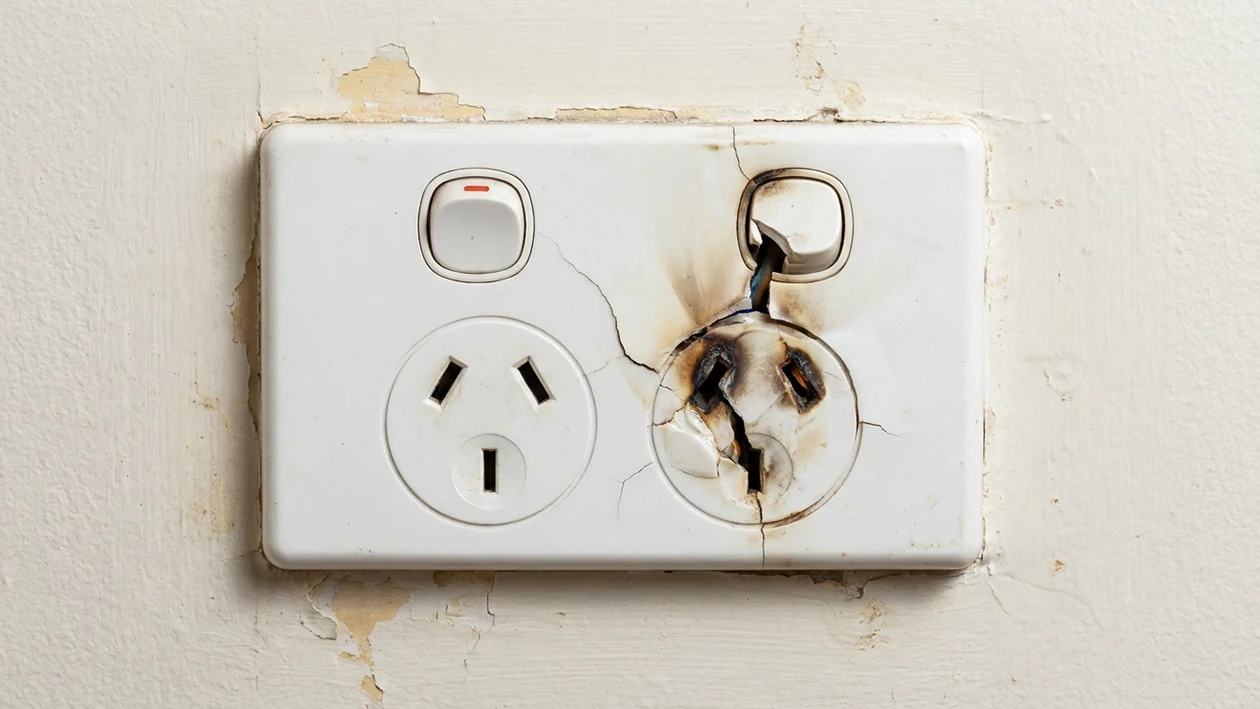
A buzzing powerpoint is not normal, and it is often the sound of electrical arcing, which is a fire hazard. If your powerpoint is buzzing, crackling or sizzling, switch the powerpoint off at the wall, unplug the appliance, and turn off the power at your switchboard if the noise continues. Then call a licensed electrician.
Work through the steps below in order.
Step 1: Match your noise (the sound self-assessment)
Not every electrical noise is dangerous, but some are extremely dangerous. Listen carefully and match what you are hearing to the descriptions below.
“Fizzing, sizzling or crackling” (like bacon frying)
Diagnosis: active electrical arcing. Loose or damaged wiring is causing electricity to jump across a gap, creating intense heat behind the faceplate.
Danger level: CRITICAL. Immediate fire risk.
Action: go straight to the isolation protocol below.
“Loud, sharp buzzing when an appliance is plugged in”
Diagnosis: an overloaded circuit, a failing appliance plug, or worn contact points inside the powerpoint itself.
Danger level: HIGH.
Action: unplug the appliance and follow the isolation protocol.
“Low, steady hum, especially outside or near the switchboard”
Diagnosis: normal mains vibration or transformer hum. Alternating current vibrates at 50 hertz in Australia, and that vibration is audible in some equipment. A powerpoint itself should be silent. Any noise coming from the fitting is a fault, even if it is quiet.
Danger level: LOW, unless the sound is coming from the fitting.
Action: no emergency, but worth mentioning at your next safety inspection.
Why do I only notice it at night?
Most people first hear a buzzing powerpoint after 10pm, when the house goes quiet and the fault has been there for weeks. Noticing it at night does not make it less serious. Run the same check. If it fizzes or crackles, or the faceplate is warm, isolate the circuit and call an emergency electrician. We answer 24 hours.
If the sound is fizzing or crackling, stop reading and go to the next section now.
Step 2: How to safely stop a buzzing powerpoint
To stop the noise safely, you need to physically isolate the power. Do not unscrew the faceplate, and do not poke anything into the powerpoint. Residential 240 volt work cannot legally be done by anyone but a licensed electrician in Australia, and the wiring behind that plate is live.
The isolation protocol:
- Stop touching the appliance. Make sure your hands are completely dry before you touch anything.
- Switch off at the wall. Flick the powerpoint switch to the off position.
- Unplug. Remove the plug from the powerpoint. If the buzzing stops the moment the plug comes out, the fault is in the appliance or its plug, not your wiring.
- Listen closely. If the powerpoint is still buzzing while empty and switched off, the fault is in the wall wiring. This is the serious one.
- Isolate at the switchboard. Go to your switchboard and switch off the circuit breaker or RCD labelled “Power”, “Sockets” or “GPO”. If nothing is labelled clearly, switch off the main switch.
Once the circuit is dead, the noise will stop. Leave it off and call an electrician.
Try this now
Touch the plastic faceplate with the back of your hand. Is it warm or hot? A powerpoint should always be at room temperature. If it feels warm, turn off your mains power immediately and do not switch it back on until an electrician has inspected it.
Also look for discolouration. Brown or yellow scorch marks around the plug holes mean heat has already been building up behind the plate, often for weeks.
Why you should not just tape it over and wait
People tend to assume a small electrical fault means a small fire, and that a small fire is survivable. Australian coronial data says otherwise. A 14 year national study of preventable residential fire deaths, carried out by Risk Frontiers, the Metropolitan Fire Brigade and Macquarie University for the Bushfire and Natural Hazards CRC, found that roughly half of fatal house fires burned one room or less of the structure. The fire that kills someone is usually not a blaze that consumes the house. It is a contained fire, producing enough smoke, at the wrong time of night, in a home without a working smoke alarm.
The same research found something else. Adults over 65 made up 36 per cent of the deaths.
Common mistakes to avoid
Mistake: spraying WD-40 or contact cleaner into a buzzing powerpoint.
Why it is a problem: most of these products are flammable and conductive when wet. You are spraying an accelerant into a live 240 volt fitting.
Do instead: isolate the circuit and book an electrician.
Mistake: taping over the powerpoint and ignoring it.
Why it is a problem: tape stops you using it but does nothing to the wiring behind it. If the circuit is still live, the connection keeps arcing and heating up inside the wall cavity.
Do instead: kill the circuit at the switchboard, then get the fitting replaced.
Mistake: plugging the appliance into a different powerpoint to “test” it.
Why it is a problem: if the appliance is the fault, you have just moved the problem to a second powerpoint.
Do instead: leave the appliance unplugged until it has been checked.
Why is my powerpoint buzzing or crackling?
A powerpoint buzzes when electricity meets resistance somewhere it should not. Four causes account for almost every case.
Loose terminal screws. The screws holding the wires behind the faceplate back off slowly as the metal heats and cools with use. The connection goes from tight to shaky over a few years, and the wire starts to vibrate against the terminal.
Worn internal contacts. The metal fingers that grip your plug pins lose their spring after years of plugging and unplugging. A weak grip means a poor connection, and a poor connection hums.
A faulty plug. Bent or corroded pins on the appliance sit loosely in the fitting. This is why the plug test in Step 2 matters. If the noise leaves with the appliance, your wiring is fine.
An overloaded circuit. Too many high-draw appliances on one circuit makes the wiring hum under load. Heaters, kettles, air conditioners and EV chargers are the usual suspects.
Where the gap is wide enough, electrical arcing starts, and the hum turns into a crackle. That is the point where a nuisance becomes a fire risk.
Why hasn’t my safety switch tripped?
A safety switch trips when current leaks to earth, which is what protects you from a shock. A loose wire arcing between two points inside the fitting keeps the current inside the circuit, so the RCD sees nothing wrong. A powerpoint can buzz, overheat and scorch without your switchboard ever cutting the power. Your ears are the fault detector here, not the safety switch. Your nose is the other one. An electrical burning smell from a powerpoint points to the same overheating connection.
How to stop it happening again
Skip double adapters and use a power board on the floor instead, since adapters hang off the fitting and strain the internal contacts. Pull the plug, never the cord. If your home still has the thin powerpoints from the 1970s or 80s, budget to replace them before they fail.
Can a buzzing powerpoint cause a fire?
Yes. A buzzing or crackling powerpoint can start a fire, and it can do it quickly.
The noise you are hearing is electricity jumping across a gap where a connection has come loose or a terminal has corroded. That is arcing. The arc generates extreme heat in a very small space, easily hot enough to melt copper, scorch the plastic housing and ignite the timber studs and insulation behind the wall.
This is not a rare event. Around 40 per cent of house fires in NSW each year are caused by electrical faults and electrical appliances, which works out at up to 1,800 house fires annually that could have been prevented with proper wiring checks and safety switches.
How far an electrical fire travels
Electrical fires spread further than other house fires. US national fire incident data covering 2014 to 2016, published by the U.S. Fire Administration, found that only 17 per cent of residential electrical fires stayed contained to the object they started in, compared with 64 per cent of non-electrical fires. The reason is where they start. A fire inside a wall cavity can smoulder for hours before anyone smells smoke.
The same dataset found that powerpoints were the equipment involved in ignition in 12 per cent of residential electrical fires, second only to wiring at 31 per cent. It also recorded an average loss of US$27,500 per electrical fire against US$12,510 for non-electrical fires, more than double.
Australia does not publish a directly comparable equipment breakdown, so treat those figures as overseas data. The physics behind a wall cavity fire, though, does not change at the border.
Key takeaway: buzzing means heat, and heat means fire. If you hear a buzz, treat it as a fire risk until an electrician tells you otherwise.
Test your smoke alarms now. Under NSW legislation every home must have working smoke alarms, and this is exactly the situation they exist for. Separately from that legal requirement, Australian Standard AS 3786 and NSW Fair Trading guidance recommend replacing smoke alarms once they reach ten years of age. If yours are past that, or they are the old ionisation type, ask your electrician to quote on hardwired photoelectric alarms while they are on site.
Check whether you have a working safety switch. Older homes often do not have RCD protection on power circuits, which removes an entire layer of defence against faults like this one. A switchboard upgrade is usually the fix.
Is it the wall, the appliance, or something outside?
Not every buzz in your house is coming from your wiring. Use this table to work out who you actually need to call.
| Where the sound is coming from | Sound type | Likely culprit | Who to call |
|---|---|---|---|
| Powerpoint or light switch | Crackle or sizzle | Faulty wiring or arcing | Licensed electrician |
| Inside your computer | Faint buzz or whine | Coil whine from the graphics card or power supply | IT technician, or nobody |
| Outside power lines | Deep hum or buzz | High voltage corona discharge | Your network provider (Endeavour Energy or Ausgrid) |
| Inside the walls | Buzzing or scratching | Chewed cables from rodents, or loose cable clips | Licensed electrician |
| Near the switchboard | Low steady hum | Normal transformer or meter hum | Mention it at your next inspection |
Is a buzzing power line normal? A steady hum from overhead lines is usually corona discharge, and it gets louder in rain and fog. That is normal. Loud crackling, hissing, visible sparks or a sagging line is not. Stay well clear and call Endeavour Energy or Ausgrid.
What if the buzzing is inside the wall, not the powerpoint? That points to a wiring fault behind the plaster, often a damaged cable or rodent damage. Switch off the circuit and book an electrician rather than trying to locate it yourself.
Quick decision path:
- Is the sound outside at the street or on the pole? Call your electricity network provider.
- Is it coming from your computer or a phone charger? Check the device itself, not your wiring.
- Is it coming from a powerpoint, switch, light fitting, switchboard or wall cavity? Call a licensed electrician.
How do you know it is safe again?
You are safe to leave it until we arrive when all three of these are true:
- The noise has completely stopped.
- The faceplate is cool to the touch.
- The affected circuit is switched off at the switchboard.
That is a holding position, not a repair. The underlying fault is still sitting in your wall. The permanent fix is usually replacing the powerpoint and re-terminating the wiring, and sometimes tracing the fault further back along the circuit if the cable itself has been damaged.
For most jobs this is under an hour on site. We isolate the circuit, replace the fitting, re-terminate the wiring to AS/NZS 3000 and test the circuit before we leave. If the cable behind it is damaged, we will tell you before we do anything further and quote the extra work per job, not per hour.
Get it sorted properly
Moonlight Electrical is a family owned and operated team of licensed electricians servicing the wider Sydney metropolitan area. We are available 24 hours a day, seven days a week for electrical emergencies. A buzzing powerpoint counts as one.
Book before midday and we will be there within 60 minutes or the service call is free. We quote per job rather than per hour, so you know the cost before we start, and every job is backed by our Lifetime Labour Guarantee and a 7 year warranty on electrical systems. Seniors receive a 10 per cent discount. We are also Level 2 ASP accredited, so if the fault turns out to sit between the network and your meter, we can handle that too without bringing in a second trade.
Call us on 0401 019 632.