

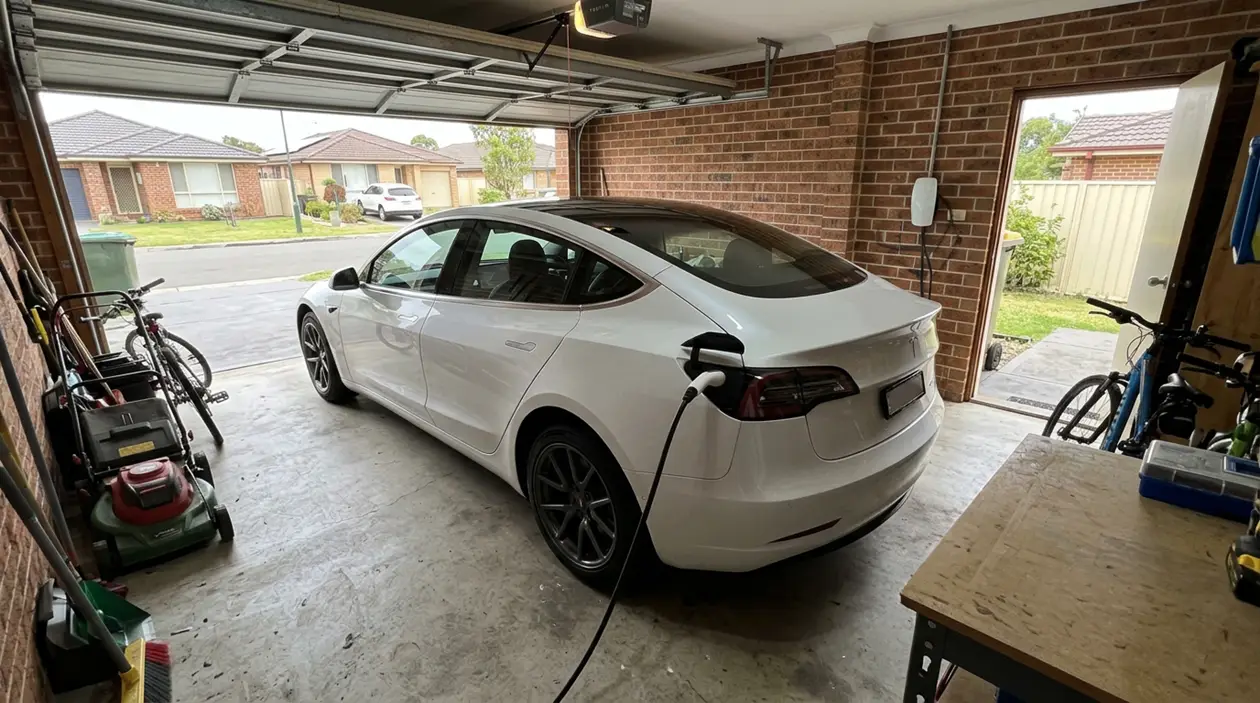
How long does it take to charge an electric car? Anywhere from about 15 minutes to over 10 hours, depending on the charger you use and the size of your car’s battery. A public ultra-rapid DC charger can take most EVs from 20% to 80% in 15–30 minutes, a 7kW home wallbox gives you a full charge overnight in roughly 6–10 hours, and a standard 10-amp wall socket trickle-charges at around 10–15km of range per hour. The charger’s power output and your battery size are what decide the time.
Below is a full breakdown by charging method, plus what it costs, how long a Tesla takes, and how to live with an EV in Sydney, whether or not you have a charger at home.
How long does it take to charge an EV in Australia?
Four things decide your charging time: the charger’s power output (measured in kW), your battery size (kWh), how full the battery already is, and the maximum your car’s onboard charger can accept. Here’s how the common options stack up for a typical mid-sized EV.
| Charging method | Typical power | Time for a usable charge | Indicative cost |
|---|---|---|---|
| Standard wall socket (10A) | ~2.0–2.4kW | ~10–15km of range per hour (overnight top-up only) | Home electricity rate |
| Home smart charger / wallbox (single-phase) | 7kW | ~6–10 hours for a full charge | Home rate — cheapest on an off-peak plan |
| Home three-phase charger | 11–22kW | ~2–4 hours for a full charge | Home rate |
| Destination AC charger (shopping centres) | 7–22kW | 2–4 hours while you’re parked | Often free or low cost; JOLT offers 7kWh free per session |
| Public DC fast charger | 50kW | ~60–90 minutes for 20–80% | ~45–80c/kWh |
| Public DC ultra-rapid charger | 150–350kW | ~15–30 minutes for 20–80% | ~45–80c/kWh |
| Petrol (for reference) | — | 2–3 minutes | ~$2 per litre |
A few things worth knowing. Charge times are quoted for the 20% to 80% window, because that’s the fast, efficient part of the curve: the last 20% always slows right down as the battery fills, which is why public chargers focus on getting you to 80%. Battery size matters too: a 40kWh hatch charges far quicker than an 80kWh SUV on the same charger. And the difference between home charging and rapid public charging comes down to AC versus DC power. We explain that in our guide to the difference between AC and DC.
For a full cost breakdown (home versus public, state by state, and how it compares to petrol), see our guide on how much it costs to charge an electric car in Australia.
How long do popular EVs take to charge?
Charging time varies a fair bit between models, and it comes down to two figures: how much power the car’s onboard charger accepts for AC (home) charging, and how fast it can take DC (public) charging. Here’s how some of Australia’s most popular EVs compare.
| Model | Usable battery | Max AC (home) rate | Full charge on a 7kW home charger | Public DC fast charge (10–80%) |
|---|---|---|---|---|
| Tesla Model Y | ~60–78kWh | 11kW | ~9–12 hours | ~25–30 min (up to 250kW) |
| BYD Atto 3 | ~50–60kWh | 7kW (single-phase) | ~8–9 hours | ~40–55 min (up to 88kW) |
| MG4 | ~51–77kWh | 6.6kW (11kW on Long Range) | ~8–11 hours | ~28–37 min (up to ~140kW) |
| Zeekr 7X | 75–100kWh | 22kW (three-phase) | ~11–15 hours | ~10–16 min (800V, up to ~460kW) |
The home-charge figures above are for a standard 7kW wallbox, which charges every one of these cars overnight. For home charging, the number that matters is the car’s max AC rate. The BYD Atto 3 and most MG4 variants cap at around 6.6–7kW on a single phase, so a three-phase wallbox won’t charge them any faster. A 7kW charger is the sensible choice. The Tesla Model Y (11kW) and Zeekr 7X (22kW) can charge faster on three-phase, so they’re worth pairing with a three-phase unit if your home supports it. Either way, it’s worth having your switchboard checked. Here’s how to get three-phase power at home, and we can advise on the right home charger for your car.
The DC fast-charging column is the road-trip story. An 800V car like the Zeekr 7X can add most of its range in 10–16 minutes, while the Atto 3’s 70–88kW ceiling means a 40–55 minute stop. For day-to-day driving at home, though, that difference rarely matters. You simply plug in overnight. Figures are indicative and vary by variant, battery condition, temperature and charger, so always check your specific model.
How long does it take to charge an EV at home?
Around 80% of EV owners do most of their charging at home, and for good reason: it’s the cheapest and most convenient option. You simply plug in when you get home and wake up to a full battery.
7kW home wallbox — the standard choice
A 7kW single-phase charger adds roughly 40km of range per hour and fully charges most EVs in 6–10 hours overnight. For the average Australian driver doing around 40km a day, that’s far more than you’ll ever need on a single night. A home charger has to run on its own dedicated, RCD-protected circuit installed by a licensed electrician. You can read more on our EV charger installation page.
Three-phase 11–22kW — for faster charging
If you have a larger battery, drive long distances daily, or simply want quicker turnaround, a three-phase charger can cut a full charge down to 2–4 hours. This requires three-phase power at the property. Here’s how to get three-phase power at home. Either way, it’s worth having your switchboard checked first, as older boards may need a switchboard upgrade to handle the extra load.
Standard 10A socket — the slow but simple option
Plugging into a normal power point adds only about 10–15km of range per hour, so it suits low-kilometre drivers or as a backup. If you rent or want a low-cost start, a dedicated 15-amp outdoor power point lets you charge safely with a portable cable while you decide on a permanent unit.
How long does it take to charge a Tesla?
A Tesla follows the same rules as any other EV: the charger decides the speed. On a 7kW Tesla Wall Connector at home, expect a full charge overnight (around 6–10 hours depending on the model). On a Tesla Supercharger, which delivers up to 250kW or more, most Teslas go from 10% to 80% in 15–30 minutes. Many newer Superchargers are now open to non-Tesla EVs as well. If you’d like a Wall Connector set up at home, we install Tesla and all other major brands. See our EV charger installation service.
Is it worth buying an electric car without a home charger?
Short answer: yes, but mainly if you have predictable access to workplace charging or live within about 5km of ultra-fast public chargers. Here’s a quick way to decide:
- Do you have charging at work? If yes, an EV is highly practical. You can top up during the day and rarely think about it.
- No workplace charging, but do you live near an ultra-fast charger? If there’s a Tesla Supercharger, Evie, Chargefox or BP Pulse site within a few kilometres, an EV is still viable; you just build a quick charge into your week.
- Neither, and you drive more than ~300km a week? A plug-in hybrid may suit you better for now, until public infrastructure expands in your area.
If you’re relying on public charging, the trick is to charge during your “idle time” rather than making dedicated trips. Map where you already spend time, such as the gym or the shops, then check the PlugShare or Chargefox app to see which of those spots have chargers, and aim to top up from 20% to 80% once a week while you’re there.
What happens if you don’t drive your EV for two weeks?
An EV loses roughly 1–2% of its charge per week when parked, often called “vampire drain”. Leaving it for a fortnight is perfectly safe if you follow a simple storage routine:
- Set the charge limit to 50–70%. Don’t leave it sitting at 100% or below 20% for long periods, as extreme states of charge are harder on the battery over the years.
- Turn off Sentry Mode and pre-conditioning. These features are the biggest drain on a parked EV.
- Leave it plugged in if you can. The car’s thermal management can then draw from the wall rather than the battery to keep things at a safe temperature on hot days.
One thing to watch: if you come back to a dead 12-volt battery and the doors won’t open, use the manual key blade to get in and jump-start the 12V system. That’s separate from the main drive battery. Follow the routine above and you should return to no more than a 2–4% drop in range over two weeks.
EV charging time FAQs
How long does it take to charge an EV from empty?
On a 7kW home charger, a full charge from near-empty takes around 6–10 hours, which is why most people charge overnight. On a 150–350kW public DC charger you’ll get from 20% to 80% in 15–30 minutes, but the final 20% is always slower.
Can I charge my EV overnight at home?
Yes. Overnight charging on a 7kW wallbox is the most common and cheapest way to charge, especially on an off-peak electricity plan. The charger needs its own dedicated circuit installed by a licensed electrician.
Does fast charging damage the battery?
Occasional DC fast charging is fine and won’t noticeably harm a modern EV battery. Relying on it for every charge can accelerate wear over many years, so most owners use home AC charging day to day and fast chargers for road trips.
How much faster is a three-phase charger?
A three-phase 22kW charger can be around three times faster than a 7kW single-phase unit, cutting a full charge to roughly 2–4 hours, provided the car can accept that rate and the property has three-phase power.
Thinking about a home charger in Sydney?
The fastest, cheapest way to charge is at home overnight on a properly installed wallbox. Moonlight Electrical is a family-owned, Level 2 accredited team installing EV chargers across Sydney and Greater Western Sydney, including the switchboard or supply work some installs need. We quote per job, not per hour, so you know the cost upfront. Call us on 0401 019 632 or learn more about our EV charger installation service.