

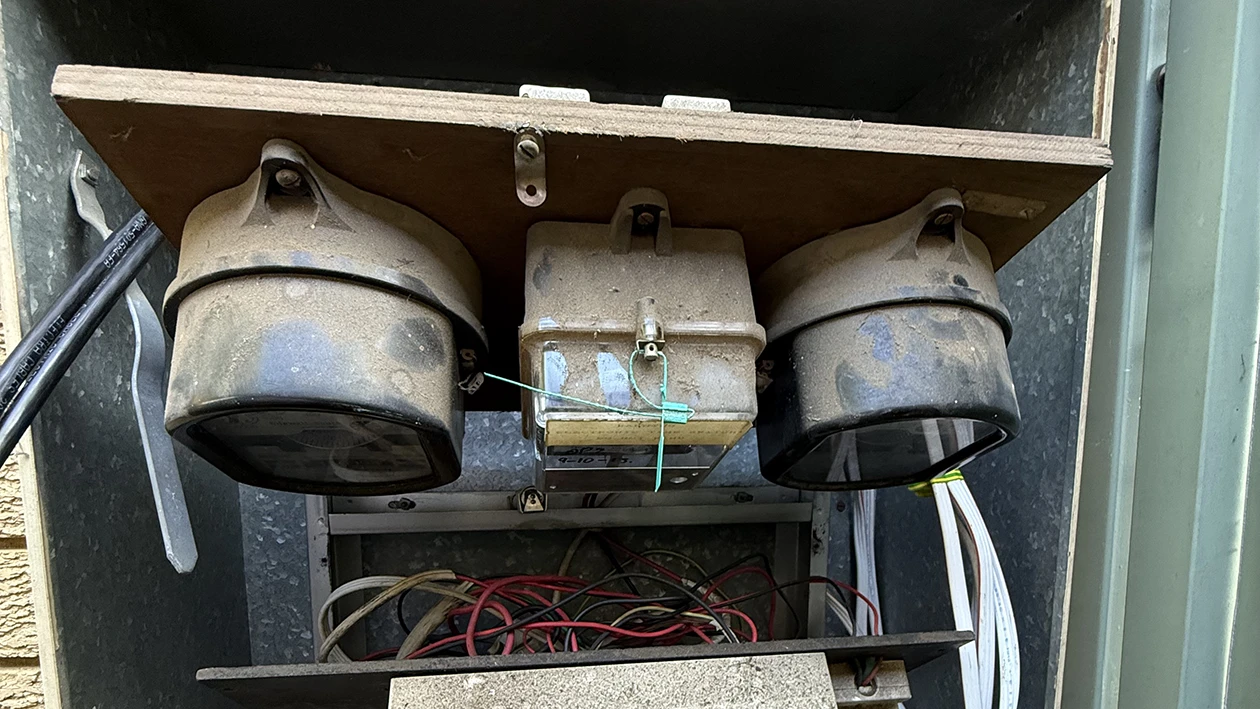
An asbestos switchboard is an electrical meter panel with a backing board made from asbestos resin or asbestos cement, used for its fireproofing and insulating properties in Australian homes from the 1920s until the mid-1980s. If your property was built or last rewired before 1990 and the board behind your meters is solid black, dark brown or grey, treat it as asbestos until an electrician confirms otherwise. Do not drill it, cut it, sand it or scrape it.
There is one detail most guides on this topic leave out, and it changes the advice considerably. According to the Asbestos Safety and Eradication Agency’s awareness guidance for electricians, older meter boxes frequently already contain loose asbestos debris in the bottom of the enclosure, left behind by drilling and installation work done years earlier. Resin board dust, millboard fragments and pieces of insulation board sit there undisturbed until somebody opens the door. The dust is already in there. ASEA’s warning is blunt about what happens next, opening the box can be enough on its own to send fibres airborne, right at face height.
The first piece of advice, then, is not to be careful when you look. It is not to look.
Asbestos was banned outright in Australia at the end of 2003, so any board installed after that date is clear. Everything older needs checking, and the checking is best done by someone with the training and the gear.
How to tell if a switchboard contains asbestos
You can get a long way on age alone, without touching the meter box. Work through these in order and stop at the point where you would need to open something.
1. The age check (do this first)
Was the house built, rewired or upgraded between roughly 1920 and 1990? If yes, assume asbestos and treat the board accordingly. ASEA’s position is that a property built or renovated before 1990 is likely to contain asbestos in some form somewhere. Homes across Merrylands, Guildford, Granville and Chester Hill from that era very often still have the original backing board sitting behind a newer set of meters.
Age on its own is enough to justify getting it looked at. No visual check needed.
2. What you can see without opening anything
If the enclosure has a clear panel, a broken door or a section already missing, you may be able to see the board without touching it. Look from a distance. Asbestos backing boards are usually solid black, very dark brown or grey, with a dense compressed sheet appearance and a slightly chalky matte finish. Modern boards are white, cream or light grey moulded plastic.
Do not lean in, reach past live parts or move anything for a better view. A meter box holds live components at 230 volts, and on an old installation the asbestos is the second hazard in there, not the first.
3. The brand check (from a photo, not from your face)
Australian asbestos electrical boards carried brand stamps. ASEA specifically names Ausbestos and Zelemite as common markings on these black resin boards. The full list worth knowing:
- Zelemite
- Ausbestos
- Lebah
- Miscolite
These stamps are usually faint and often part-covered by wiring. If the board is already visible, photograph it from a safe distance and zoom in on the image afterwards. Never zoom in with your body. If it is not visible, leave it for the electrician, who will be in appropriate protective equipment when the box comes open.
4. What else is hiding in an old meter box
The backing board gets all the attention, but it is not the only asbestos in there. ASEA’s guidance points to asbestos cement, insulation board and millboard used as side, back and top linings inside the enclosure itself, along with woven asbestos textile linings inside both large and small fuse carriers. Millboard is the paper-like form. It crumbles under finger pressure and releases fibres far more readily than the solid resin board does.
This matters if you still have ceramic fuses. Pulling a fuse carrier in and out of an old board is a routine thing for a homeowner to do when a circuit drops out, and on some installations that carrier is lined with asbestos textile. If your board still runs on rewireable fuses, that alone is worth a conversation about a switchboard upgrade.
How to read the results
Pre-1990 property plus any one visual sign is enough to proceed on the basis that it is asbestos. Two or more signs and there is very little doubt. One sign on its own still warrants a look from a licensed electrician, because the cost of being wrong is high and the cost of an inspection is not.
One more sign to look for. If the wiring running out of the board is wrapped in black woven cloth rather than modern PVC, you are almost certainly looking at a pre-1960s installation. That cloth sheathing frequently contains asbestos too, and the rubber underneath it will have gone brittle decades ago. We have covered that cable type in our guide to VIR cable and what it means for your home.
What to do today
- Keep the meter box door closed and, if it has one, locked. Given what ASEA says about debris already sitting inside old enclosures, this is the single most useful thing you can do.
- Work out the age of the property and any rewiring. That is most of the assessment done.
- Tell anyone doing work at the property. Air conditioning installers, solar installers, NBN technicians and antenna fitters all end up near the meter box, and a drill through a Zelemite board is the most common way these things get disturbed.
- Book an inspection rather than guessing. Our electrical safety inspection covers the board condition, the wiring behind it and whether an upgrade is needed.
Is an N95 mask enough for asbestos?
No. An N95 does not seal reliably against the face and is not the Australian rating for asbestos work. P2 is the minimum. ASEA’s guidance to electricians is to carry a P2 cartridge half face mask along with disposable P2 masks as backups, and it makes the point that the mask only works if it is fitted properly every single time.
That answer often gets read as a shopping list. It is not one. Buying the right mask does not make the work legal or safe, because the fibres are only half the hazard. The other half is a live switchboard, and in NSW only a licensed electrician can work on one. Asbestos removal beyond very small quantities of non-friable material requires a licensed removalist. A switchboard puts both problems in the same box.
If the board has already been drilled, cracked or knocked
This is the situation that actually turns up. Someone mounts a bracket, drills through the meter box, and finds black dust. What to do:
- Stop immediately. Put the tool down and leave it where it is.
- Get everyone out of the immediate area, including pets. Close the meter box door if you can do so without touching the damaged section.
- Do not sweep the dust. Do not use a household vacuum or a shop vac. Domestic vacuums do not filter asbestos fibres and will spray them straight back into the air through the exhaust.
- Do not hose or spray the area. Wetting is standard practice for asbestos generally, and licensed workers do carry spray bottles, but not at a switchboard, where you would be introducing water to live electrical equipment.
- Keep the area clear and call a licensed asbestos removalist along with a Level 2 electrician. Bag the clothing you were wearing separately and do not put it through the household wash until you have advice.
If power has been lost or you can see damaged live conductors, that is an emergency. Call our 24/7 emergency electrician line on 0401 019 632 and stay away from the board.
Will a short exposure hurt you?
A single brief exposure, such as being in the room when someone drills a board, is very unlikely to cause asbestos related disease. The illnesses associated with asbestos, including asbestosis and mesothelioma, are overwhelmingly linked to repeated exposure over years.
The timescale is longer than most people assume. Research cited in the AIHW’s Mesothelioma in Australia 2024 report found the median time between first exposure and diagnosis has stretched from 24 years for cases occurring between 1960 and 1979, to 52 years for cases between 2010 and 2020. Half a century, in other words, between the drill going through the board and anyone knowing about it. That is precisely why the response to a disturbance today is to document it rather than to wait and see.
Health authorities are clear that there is no established safe level of exposure, so the honest answer is that a one off incident carries a small but non-zero risk rather than no risk at all. That is not a reason to panic. It is a reason to avoid a second incident and to handle the first one properly.
Why electricians take this more seriously than most trades
The same AIHW report includes exposure assessments from people diagnosed with mesothelioma who volunteered for interview. Among participants who had worked in the trades, electrical trade jobs came out at the top of the list: 91% of the 115 participants with electrical trade work histories were assessed as having possible or probable occupational exposure to asbestos in that job, ahead of plumbers and gasfitters at 88% and building trades at 87%.
Two qualifiers matter. Only around 15% of people diagnosed with mesothelioma take part in the assessment, and the AIHW notes these cases mostly reflect workplace exposure from before the 2003 ban and the controls that came with it. So this is not a figure for the risk facing a licensed electrician working today. It is a figure that explains why the trade treats an old meter box the way it does.
Renovation is the bigger risk for homeowners
The same report looked at exposure outside work. The most common non-occupational context recorded was having undertaken major home renovations involving asbestos products, with 51% of those participants assessed as having possible or probable exposure. Living in a house while renovations were under way came second at 38%.
Renovation, not occupation. If you are planning work on a pre-1990 home, the meter box belongs on the list of things to identify before anyone starts, not after.
Two things that change the risk
- Fibre type matters. Chrysotile, the white asbestos most common in Australian building products, is cleared from the lungs more readily than the amphibole types such as amosite and crocidolite, which the body struggles to break down.
- Smoking compounds it substantially. Research consistently shows the combined risk of lung cancer for a smoker exposed to asbestos is far greater than either risk on its own, not simply the two added together.
If you have had a disturbance event, mention it to your GP so it goes on your record. Documenting the date and circumstances at the time is far easier than reconstructing it decades later, and on the latency figures above, decades is what you are dealing with.
Labelling: what the Wiring Rules and NSW regulations require
An asbestos switchboard that stays in place has to be identified so the next person who opens the box knows what they are dealing with. That includes meter readers, solar installers and any electrician who did not do the original work. Under the Wiring Rules and NSW work health and safety regulations, identified asbestos at a work site must be labelled and recorded.
The label itself is straightforward. It carries the word WARNING or DANGER in bold, states clearly that the board contains asbestos, and instructs that it must not be drilled or disturbed. It goes on the inside of the outer enclosure door at eye level, where it is visible before anyone touches the board itself, never on the asbestos sheet.
Fixing the label is part of the electrician’s job, not a homeowner task, because applying it means opening an enclosure with live parts and possibly loose debris inside. Your electrician will also note the board in the paperwork so the next tradesperson has a record.
Asbestos boards and defect notices
If Ausgrid or Endeavour Energy issue a defect notice on your property, an asbestos backing board is often part of the picture. Notices are graded by severity. The most serious grade means an immediate hazard, and the network can disconnect supply until it is fixed. Lower grades give you a rectification window set by the network operator, and the notice itself will state the deadline.
Common asbestos related triggers include a cracked or crumbling backing board leaving conductors poorly supported, missing or damaged enclosure doors, and boards with no asbestos labelling. Rectifying a defect notice is Level 2 work, which is why it needs an accredited service provider rather than a general electrician. We handle these regularly and have set out the process on our electrical defect notice page.
Why an asbestos board usually means an upgrade, not a repair
Here is the practical problem. Modern safety switches, extra circuits and larger main switches all need mounting, and mounting means drilling. You cannot legally or safely drill an asbestos board. That rules out most of the work people want done, including adding RCDs, running a circuit for an EV charger, or fitting a bigger main switch for an induction cooktop.
The usual answer is a full switchboard upgrade, where the asbestos board is removed under controlled conditions and replaced with a modern enclosure. You end up with proper safety switch protection, room to expand, and no asbestos sitting in the meter box. In older homes where the board comes out and the wiring behind it turns out to be perished, we will also talk you through whether a partial or full house rewire makes sense at the same time, since the two jobs overlap heavily.
Common questions
Can I open the meter box to check?
On a pre-1990 board, we would say no. ASEA’s guidance is clear that older enclosures often hold asbestos debris from earlier work, and that opening the door alone can put fibres in the air. There is nothing you can learn by opening it that an electrician cannot establish safely.
Can I paint over an asbestos switchboard to seal it?
No. Sealing products exist for some asbestos applications, but painting a live switchboard is not one of them, and it does nothing about the drilling restriction. It also hides the visual clues that tell the next electrician what they are working with.
Is an asbestos switchboard illegal?
No. Asbestos that is in place, intact and undisturbed is not illegal in a residential property. What is regulated is disturbing it, removing it and failing to identify it.
Do I have to declare it when selling the house?
Your conveyancer will tell you what you have to declare. From a practical angle, a pre-purchase inspection will usually pick up an old board anyway, and buyers tend to price in the upgrade.
How long does a switchboard upgrade take?
It depends on the board, the enclosure and what the network requires, so we will give you a firm scope after we look at it. We quote per job rather than per hour, so the figure you get is the figure you pay.
Get the board looked at properly
We do these regularly. Moonlight Electrical is a family owned and operated business based in Merrylands, servicing Western Sydney and the greater Sydney metropolitan area. We hold NSW electrical contractor licence 373818C and are Level 2 ASP accredited, so we can handle everything from the identification through to the upgrade and any network paperwork that comes with it.
Book before midday and we will be there within 60 minutes or the service call is free. All work is backed by our Lifetime Labour Guarantee and a 7 year warranty on electrical systems, and we hold a 5.0 rating on Google. Seniors receive 10% off.
Call us on 0401 019 632 or request a quote online. If you think the board has already been disturbed, call rather than email so we can talk you through it straight away.