

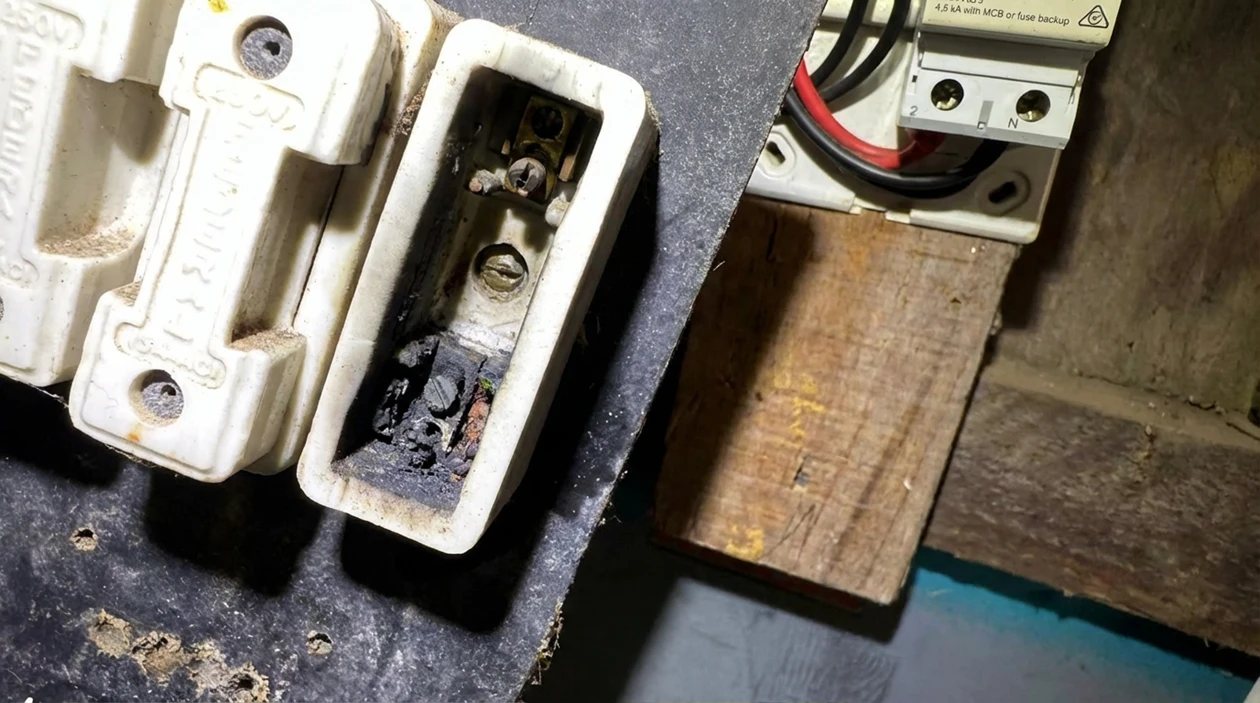
A short circuit occurs when electricity strays from its intended path and completes a circuit with little to no resistance, causing an immediate surge of current. This usually trips your circuit breaker to prevent fire.
Important Safety Note: In Australia, working on fixed wiring is illegal for unlicensed individuals. This guide focuses on safe diagnosis of appliances and when to call a professional.
Immediate Warning Signs: When to Call an Electrician Now
Before you do anything else, run through this quick safety checklist. These warning signs indicate a potentially dangerous situation that requires professional attention.
The “Stop & Look” Checklist:
- Is there a fishy or burning plastic smell? (Call immediately)
- Are power outlet covers warm to the touch?
- Is there visible scorching or black marks around an outlet?
- Is the breaker tripping instantly when you reset it?
- Are lights dimming or flickering heavily?
If you ticked any of the above, leave the breaker OFF and call a licensed emergency electrician straight away. These signs can indicate overheating wires, melting insulation, or active arcing, all of which pose serious fire risks.
How to Trace a Short Circuit (The Isolation Method)
Here’s some good news: most “house shorts” are actually faulty appliances plugged into the wall, not the wall wiring itself. You can identify the culprit yourself without any tools.
Step 1: Turn Off the Breaker
Locate your switchboard and ensure the tripped switch is completely in the OFF position. Some breakers sit in a middle position when tripped—push it fully off before attempting to reset.
Step 2: Unplug Everything
Go to every room on that circuit and unplug every single device. This means lamps, toasters, phone chargers, televisions, microwaves, everything. Don’t just switch them off at the wall; physically remove the plug.
Step 3: Reset the Breaker
Push the switch back to the ON position.
- If it trips immediately: The short is in the fixed wiring. STOP here. You need a licensed electrician.
- If it stays on: The short is in one of your appliances. Continue to Step 4.
Step 4: The Re-Plug Test
With the breaker holding, plug your appliances back in one at a time. Wait a few seconds between each one. The appliance that trips the breaker is your faulty item.
Quick Reference: Unplug everything → Reset breaker → Re-plug one by one → Identify the culprit.
Repair Costs: What to Expect from an Electrician
Yes, an electrician can absolutely fix a short circuit, it’s a standard, routine repair for any qualified sparky.
Typical Cost Breakdown:
- Standard call-out fee: $80–$150 (covers arrival and the first 30 minutes of work)
- Hourly labour: $80–$120 per hour for tracing complex wiring faults
- Materials: Additional costs for replacing damaged cable, outlets, or switches
| Situation | Recommended Action |
|---|---|
| Faulty lamp, toaster, or small appliance | Replace the appliance (usually cheaper than repair) |
| Faulty power tool or expensive equipment | Consider professional appliance repair |
| Fault in wall wiring | Must hire a licensed electrician (legal requirement) |
Keep in mind that attempting DIY repairs on fixed wiring isn’t just dangerous, it’s illegal in Australia and can void your home insurance.
Expert Tip: If you want to ensure your home electrical wiring is safe, arrange for an electrical Certificate of Compliance.
Using a Multimeter to Test Appliances
If you want to confirm whether an appliance has an internal short before throwing it out, a basic multimeter can help. This test is only for unplugged appliances, never test anything connected to mains power.
How to Test for a Short Circuit
- Set your multimeter to continuity mode (usually shown as a sound wave or diode symbol). Some meters require you to select the Ohms (Ω) setting instead.
- Touch one probe to the active prong of the appliance plug (the angled pin on Australian plugs).
- Touch the other probe to the neutral prong (the other angled pin).
- Read the result:
- Zero resistance or a continuous beep = Short circuit present (faulty appliance)
- High resistance or no beep = No short detected (appliance likely fine)
If your multimeter confirms a short, the appliance has internal damage and should be replaced or professionally repaired.
Prevention and the 80% Rule
Understanding why short circuits happen can help you prevent them in the future.
The 80% Rule Explained
Electrical best practice suggests you should only load a circuit to 80% of its maximum capacity. On a standard 20-amp circuit, that means keeping your total draw to 16 amps or less. This prevents overheating, reduces wear on your wiring, and minimises nuisance tripping.
Common Causes of Short Circuits:
- Loose connections: Wiring naturally loosens over time, especially at junction points and outlets
- Damaged insulation: Rodents chewing through cables, nails driven through walls during renovations, or simply aged and brittle insulation
- Faulty appliances: Internal component failure, water damage, or manufacturing defects
Understanding the Difference
If your breaker trips occasionally, especially when you’re running multiple high-draw appliances like the kettle, toaster, and microwave simultaneously, you likely have an overload issue. Consider spreading your appliances across different circuits.
If your breaker trips instantly every time you reset it, that’s a short circuit. The electricity is finding a direct path where it shouldn’t, and you’ll need to trace the fault using the isolation method above.