

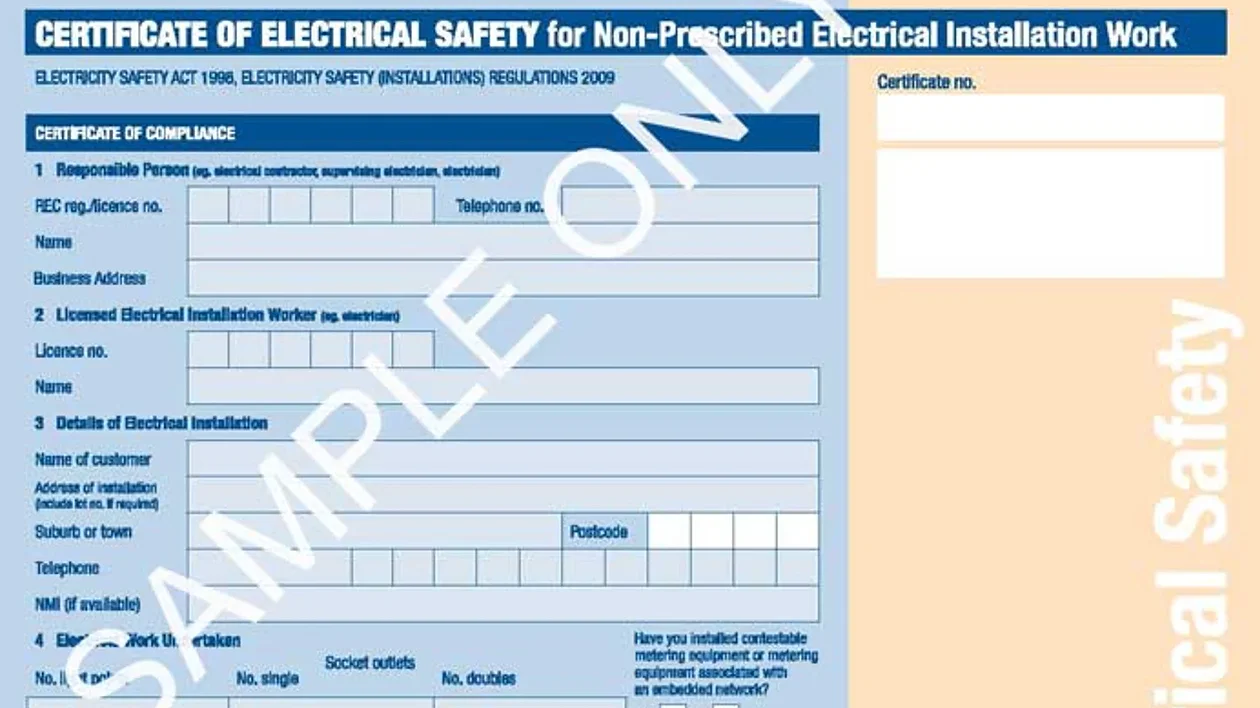
What Is the Purpose of an Electrical Compliance Certificate?
An Electrical Certificate of Compliance (CoC), also known as a CCE, COES, CCEW or notification, depending on your state, is a mandatory legal document. It certifies that electrical work complies with Australian Standards (AS/NZS 3000) and proves the work was tested and is safe for use. This testing ensures that circuits are not overloaded, a common cause of a blown fuse, and that all protection devices are functioning correctly.
Think of this certificate as your warranty for the electrical work. Without it, you may face serious problems when making a home insurance claim or selling your property. Insurers and conveyancers routinely ask for these documents, and not having them can delay settlements or void coverage entirely.
State Terminology Decoder
Each state uses different names for essentially the same document:
- VIC: Certificate of Electrical Safety (COES)
- NSW: Certificate of Compliance – Electrical Work (CCE/CCW/CCEW)
- QLD: Certificate of Testing and Compliance
- WA: Electrical Safety Certificate
- SA/TAS/NT: Certificate of Compliance
Don’t be thrown off by the different names—they all serve the same purpose.
Do I Need a Compliance Certificate?
YES, you need one for:
- Installing a new power point
- Replacing a broken light switch
- Hardwiring an oven, cooktop, or air conditioner
- Adding new circuits or upgrading your switchboard
- Installing ceiling fans or exhaust fans
- Any work involving fixed wiring
NO, you don’t need one for:
- Changing a light bulb
- Plugging in an appliance
- Resetting a tripped circuit breaker
A common grey area is downlight replacement. You can change a plug-in downlight yourself without a certificate, but replacing a hardwired fitting is fixed wiring work — meaning it requires a licensed electrician and a compliance certificate. Our guide to replacing downlights explains how to tell which type you have and what the job should cost.
What If My Electrician Did Not Give Me a Certificate?
Licensed electricians in Australia are legally required to provide a certificate within a specific timeframe (usually 30 days) after completing the job. Withholding this document is a breach of regulations. Never assume the work is safe just because the lights turn on. If your electrician withholds the certificate, the work may not be up to standard. If a network inspector later finds non-compliant wiring, you will be the one liable to rectify a defect notice at your own cost.
Step-by-Step: Getting Your Missing Certificate
Step 1: Check your records first
Look through your email spam folder and check any invoices or receipts. Sometimes the certificate reference number is included on paperwork, or the PDF was filtered out of your inbox.
Step 2: Request it in writing
Send a polite but firm email requesting the document. This creates a paper trail if you need to escalate.
Step 3: Report to your state regulator
If the electrician refuses or ignores your request, lodge a complaint with the relevant electrical safety authority in your state.
Copy-and-Paste Email Template
Use this script to request your certificate:
Subject: Required: Certificate of Compliance for work at [Your Address]
Hi [Electrician’s Name],
Please forward the Electrical Certificate of Compliance reference number or PDF for the work completed on [Date of Work].
As per [Your State] regulations, I require this for my records and insurance purposes. Please send this through within 48 hours.
Thanks,
[Your Name][Your Phone Number]
What If the Electrician Has Gone Out of Business?
This is trickier. You’ll need to hire an independent licensed electrician to conduct a full safety inspection of the work and issue a new certificate. Unfortunately, this cost falls on you, expect to pay between $200 and $450 or more depending on the scope of work being inspected.
How Much Does an Electrical Certificate of Compliance Cost?
The administrative fee for the certificate itself is relatively low (approximately $0–$70 depending on the state), but the real cost depends on your situation.
Cost Breakdown by Scenario
| Scenario | Estimated Cost | What You’re Paying For |
|---|---|---|
| New Installation | $0 / Included | Should be built into the electrician’s quote |
| Retrospective Check | $200 – $450+ | Electrician’s time to inspect, test, and assume liability for old work |
| Government Filing Fee | $10 – $40 | Raw cost the regulator charges (often passed to you) |
| Copy of Lost Certificate | $0 – $50 | Admin fee for retrieval from state database |
Before You Hire: Check the Quote
Always look for a line item mentioning “Certification,” “Notification,” or “Compliance Certificate” on your quote. If it’s not there, ask whether it’s included. A reputable electrician will never hesitate to confirm this.
Who Can Issue a Certificate of Compliance?
Only a fully licensed electrician (A-Grade or equivalent in your state) can issue a compliance certificate. Apprentices, electrical workers under supervision, and unlicensed handymen cannot legally sign off on electrical work.
This matters because the person who signs the certificate is assuming legal liability for the safety of that work. No qualified electrician will put their licence on the line for work they didn’t complete or supervise themselves.
It is important to note that the type of license matters. While a standard electrician can certify internal wiring, work that involves disconnecting power from the street, handling metering equipment, or upgrading consumer mains requires a Level 2 electrician. These Authorised Service Providers (ASP) hold the specific qualifications needed to certify connections to the electricity grid.
Can I Make My Own Certificate of Conformity?
No. In Australia, you cannot create your own certificate. DIY electrical work on fixed wiring is illegal in every state and territory.
Even if you do complete electrical work yourself, a licensed electrician will almost certainly refuse to sign a certificate for it. Why? Because signing that document makes them legally liable for any faults, shocks, or fires caused by your work. No professional will accept that risk.
The real cost of DIY electrical work: Beyond the legal penalties, doing it yourself voids your home insurance. If a fire starts from faulty wiring you installed, your insurer can refuse to pay out, leaving you with nothing.
CE Marking vs. Certificate of Compliance
Don’t confuse these two things. “CE” is a European product safety standard you’ll see stamped on imported appliances and equipment. It has nothing to do with Australian electrical installation certificates.
A product having a CE stamp does not remove the need for a compliance certificate when that product is hardwired into your home.
How Can I Get My CoC Certificate Online?
Retrieving a certificate online depends on your state. Australia doesn’t have a single national database for electrical certificates, so you’ll need to contact the right authority.
State-by-State Lookup Resources
- Victoria: Energy Safe Victoria (ESV) Public Register — https://www.energysafe.vic.gov.au/
- NSW: Fair Trading NSW — Certificates are typically emailed directly to customers; contact Fair Trading if you need a copy retrieved
- Queensland: Electrical Safety Office — electricalsafety.qld.gov.au
- South Australia: Office of the Technical Regulator
- Western Australia: Building and Energy (EnergySafety)
- Tasmania: Consumer, Building and Occupational Services (CBOS)
How to Track Down an Old Certificate
- Check your meter box. Electricians often leave a sticker or logbook entry recording the work done, including their licence number and date.
- Find the electrician’s licence number. This is usually on the invoice or the meter box sticker.
- Contact your state regulator. Provide the property address, approximate date of work, and electrician’s details if you have them.
Is an Electrical Certificate of Compliance Mandatory?
Yes. For almost all electrical installation work—new circuits, alterations, additions, switchboard upgrades or replacements, a certificate is mandatory by law across Australia.
The only exceptions are genuinely minor maintenance tasks that don’t involve fixed wiring, such as changing light globes or plugging in appliances.
For everything else, from adding a single power point to rewiring an entire house, your electrician must lodge the paperwork and provide you with proof of certification.
The Bottom Line
An electrical compliance certificate isn’t just paperwork for paperwork’s sake. It’s your proof that the work is safe, your protection if something goes wrong, and a legal requirement that every licensed electrician must fulfil.
Don’t pay the final invoice until you have seen the certificate or have it in hand.
If your electrician can’t, or won’t, provide one, that’s a serious red flag. Use the email template above, escalate to your state regulator if needed, and never accept excuses for missing documentation.
Your home’s safety and your insurance coverage depend on it. Want to hire an electrician who understands and complies with electrical compliance certificate requirements, speak to the electricians at Moonlight Electrical today!