

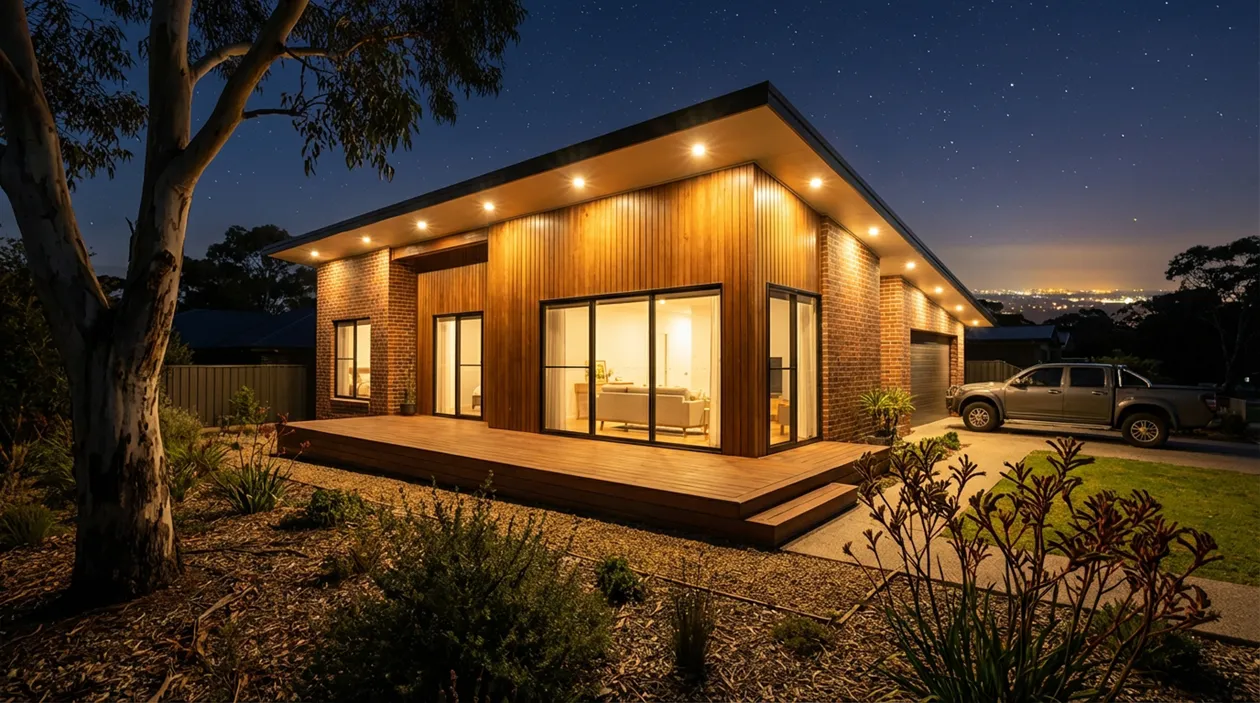
Yes, downlights in eaves are excellent for boosting home value and security, provided you use IP65-rated (waterproof) fittings and IC-4 rated (insulation contact) LEDs to prevent fire hazards.
That’s the short answer. But here’s what separates a professional-looking installation from a botched DIY disaster: placement. Install your lights too close to the wall and you’ll highlight every imperfection in your brickwork. Too far out and you’ll create ugly shadow zones that defeat the purpose entirely.
This guide covers everything Australian homeowners need to know before calling the sparky, from the exact specifications to ask for at Bunnings, to the spacing formula that prevents the dreaded “spotlight runway” effect.
Can You Put Downlights Under Eaves?
Yes, putting recessed lights in the soffit is standard practice for modern Australian homes. It’s one of the most effective ways to add exterior lighting without bulky wall-mounted fixtures cluttering your facade.
But before you start marking positions, you need to verify your soffits can actually accommodate downlights and understand the different installation options available.
Are Soffit Lights a Good Idea?
Soffit downlights deliver two major benefits that justify the installation cost.
Security: A well-lit perimeter eliminates hiding spots around your home’s exterior. Unlike motion-sensor floodlights that only activate after someone’s already in your yard, soffit downlights provide constant low-level illumination that deters opportunistic intruders before they approach.
Aesthetics: Downlights wash your walls with soft, even illumination that highlights architectural features, rendered finishes, timber cladding, stonework. The effect transforms how your home presents after dark, creating depth and dimension instead of the flat, harsh look you get from a single porch light. If you are trying to replicate the warm look of traditional bulbs, read our guide on the difference between LED and incandescent lighting to ensure you choose the right colour temperature.
The key is proper placement. Done well, soffit lights create a welcoming glow that draws the eye to your home’s best features. Done poorly, you get the interrogation-room effect that makes your house look like a service station forecourt.
Do Soffit Lights Increase Home Value?
Curb appeal directly impacts property value, and exterior lighting is one of the highest-return upgrades you can make.
Real estate agents consistently report that homes with quality outdoor lighting photograph better for listings, attract more inspection traffic, and create stronger first impressions during evening viewings. While it’s difficult to isolate the exact dollar value, the upgrade typically pays for itself at sale, particularly in competitive markets where buyers compare similar properties.
Beyond resale, you’ll benefit from the security and aesthetic improvements every single night you live there. Few home upgrades deliver both immediate lifestyle benefits and long-term value retention.
Can You Hang Lights From a Soffit?
There’s an important distinction between recessed downlights and pendant or hanging fixtures.
Recessed downlights sit flush with the soffit surface. They’re the most common choice for eaves because they’re weatherproof, unobtrusive, and illuminate walls evenly without creating glare at eye level.
Pendant lights hang below the soffit on a cord or chain. These work for covered outdoor areas like verandahs and alfresco spaces where you want decorative fixtures visible from below. However, they’re not suitable for exposed eaves—wind causes swinging, rain damages unprotected fittings, and the hanging mechanism creates structural stress on the soffit material.
Surface-mounted fixtures attach to the soffit face without recessing. These are a compromise solution when your soffit lacks the depth for recessed fittings (common with older timber soffits under 40mm thick). When modern surface-mounted downlights are installed, they mimic the appearance of recessed fittings while requiring no cavity space.
For standard eave applications, recessed IP65-rated downlights remain the best choice for durability, aesthetics, and performance.
What Downlights Are Suitable for Soffits?
You must use IP65-rated LED downlights for outdoor soffit installation. This rating means the fitting is completely dust-tight (the “6”) and protected against low-pressure water jets from any direction (the “5”) essential for surviving Australian storm seasons.
Choosing the wrong rating leads to corrosion, water ingress, and premature failure. Here’s what you need to know before buying.
IP65 is the minimum standard for exposed outdoor soffits. Anything less creates problems.
IP44-rated fittings protect against splashing water and objects larger than 1mm—adequate for bathrooms and covered porches, but not for eaves exposed to driving rain. During summer storms, rain doesn’t fall straight down; it hits horizontally. IP44 fittings have gaps that allow this angled water penetration, leading to internal corrosion you won’t see until the fitting fails.
IP65-rated fittings seal completely against dust and withstand water jets from any angle. This handles the worst Australian weather—horizontal rain, hose splashback when you’re washing the car, even pressure-washer overspray during exterior cleaning.
Some premium outdoor downlights carry IP66 or IP67 ratings, offering protection against powerful water jets or temporary immersion. These are overkill for standard eave applications but worth considering for coastal properties where salt spray accelerates corrosion.
Do LED Downlights Need Ventilation?
No, modern LED downlights with proper Insulation Contact (IC) ratings don’t require ventilation holes in the soffit.
This is a hangover from the halogen era. Halogen downlights ran extremely hot, hot enough to ignite nearby materials if heat couldn’t escape. Ventilation gaps in the soffit allowed hot air to dissipate, preventing fires but also letting in possums, birds, insects, and moisture.
Modern LED downlights generate a fraction of the heat. Combined with integrated heat sinks that dissipate warmth through the fitting body, they’re designed to operate safely in sealed cavities. Cutting ventilation holes in your soffit actually creates problems, it defeats the purpose of a sealed soffit lining and invites pests into your roof space.
The exception: if you’re installing non-IC-rated LEDs in a cavity with insulation, you may need air gaps. But rather than cutting holes, the simpler solution is buying the correct IC-rated fittings in the first place. If you still have halogen downlights elsewhere in your home, it’s worth considering an upgrade — our guide to replacing old downlights with LEDs covers the costs, layout rules, and what you can do yourself versus what needs a licensed electrician.
How to Protect Eave Downlights From Insulation?
If your soffit has insulation batts above it (common in newer energy-efficient homes), you need IC-rated downlights.
IC stands for Insulation Contact. Standard downlights require clearance from insulation, typically 50mm or more—to prevent heat buildup. In a soffit cavity, maintaining this clearance is often impossible.
IC-4 rated downlights are specifically designed for direct contact with insulation. They incorporate superior heat management that keeps surface temperatures safe even when completely covered by batts. You can lay insulation directly over the fitting without creating a fire hazard.
Not sure if your soffits have insulation? In homes built after 2010, assume they do—energy regulations increasingly require insulation in external ceilings and soffits. Buy IC-4 rated fittings regardless; the price difference is negligible, and you eliminate any fire risk from improper clearances.
| Specification | Minimum Requirement | Notes |
|---|---|---|
| IP Rating | IP65 (front face) / IP44 (driver) | IP65 front protects against rain; driver can be IP44 if mounted inside roof cavity |
| IC Rating | IC-4 | Non-negotiable if insulation present above soffit |
| Beam Angle | 60° for focused accent lighting / 100° for general wash | Narrower beam = more dramatic; wider beam = more even coverage |
| Colour Temperature | 3000K (warm) for brick and timber / 4000K (cool) for modern grey render | Warm light flatters natural materials; cool light suits contemporary finishes |
| Cutout Size | 90mm (standard) or 70mm (mini) | Measure your soffit thickness—some can’t accommodate standard depth |
| Wattage | 8W–12W per fitting | LEDs—anything higher is overkill and creates glare |
How Far Apart Should Downlights Be in a Soffit?
The general rule is 1.2m to 1.5m apart, or half your ceiling height. This spacing creates overlapping “cones” of light that blend seamlessly without leaving dark gaps or creating an overlit runway effect.
Poor spacing is the number one reason eave downlight installations look amateur. Get this right and your home looks professionally designed; get it wrong and you’ve wasted money on fittings that make your facade look worse, not better.
Where to Place Soffit Lights?
Distance from the wall is just as important as spacing between lights—and it’s where most DIY planners go wrong.
Too close to the wall (under 150mm): Creates “wall grazing”—dramatic shadows that highlight every surface imperfection. Great for feature stonework or textured render you want to emphasise. Terrible for painted brick with visible mortar repairs or render with patch marks.
The sweet spot (200mm–300mm from wall): Provides even wall washing without harsh shadows. Imperfections are softened rather than highlighted. This is the correct distance for most residential applications.
Too far out (over 400mm): Creates a floor-wash effect rather than wall illumination. The light falls at your feet instead of highlighting the building facade. Useful for pathway lighting but defeats the purpose of eave downlights.
For standard Australian eaves, positioning lights 200mm–300mm out from the fascia face gives the best results. Measure from the wall surface, not the fascia board edge.
How Far Apart Should LED Downlights Be Placed in Australia?
Australian homes typically have eave widths between 450mm and 600mm. This impacts where you can position your downlights.
Narrow eaves (450mm): You’ll likely be limited to a single row of downlights centred in the soffit. With 200mm clearance from the wall, you’ll position lights approximately 250mm from the fascia edge. Stick to the 1.2m–1.5m spacing rule along the length.
Standard eaves (600mm): More flexibility. Position lights 200mm–300mm from the wall face, which places them roughly in the middle third of the soffit. Same spacing rules apply along the length.
Wide eaves (900mm+): Consider two rows of downlights—one closer to the wall for facade washing, one near the fascia edge for ground illumination. Stagger the rows so lights don’t align directly, creating more even coverage.
Regardless of eave width, never place a downlight directly on a corner. Start your spacing from each corner and work inward. The first light should sit approximately half your standard spacing distance from the corner (600mm for standard spacing).
What Size Recessed Lights for Soffit?
The two standard sizes are 90mm (standard) and 70mm (mini) cutouts.
90mm downlights are the default choice. They accommodate larger LED arrays for higher light output and better heat dissipation. Most soffit materials handle this cutout size without structural concerns.
70mm downlights suit situations where 90mm won’t work: shallow soffits with limited cavity depth, older timber soffits where larger holes might weaken the material, or aesthetic preferences for a more subtle fixture presence.
Before ordering, check your soffit depth. Recessed downlights need 60mm–100mm of cavity space behind the soffit face. If your cavity is shallower than your chosen fitting’s depth, you’ll need surface-mounted alternatives or ultra-slim profile downlights (some modern LEDs need only 30mm depth).
Use the coat hanger test: drill a small pilot hole, insert a bent wire, and rotate 360 degrees to verify clearance. If you hit a rafter or noggin, move your position, don’t try to force a fitting into inadequate space.
Can You Install Lights on Eaves Without Recessing?
Yes, alternatives exist for homeowners who can’t or don’t want to cut holes in their soffits. Fascia-mounted fixtures, gutter clips, and surface-mounted downlights all provide outdoor lighting without penetrating the soffit surface.
These options suit older homes with asbestos soffits (which must never be drilled), heritage properties where modifications are restricted, rental properties where you can’t make permanent changes, or simply situations where recessing isn’t practical.
How to Attach Lights to Fascia?
Fascia boards—the vertical trim that covers rafter ends at your roofline—offer solid mounting points for exterior lighting. Two main approaches:
Direct drilling: Surface-mount fixtures screw directly into the fascia timber. This creates permanent, secure mounting but requires pilot holes and waterproof sealing around penetrations. Works best with painted timber fascias; avoid drilling powder-coated aluminium fascias as the holes expose bare metal to corrosion.
Clamping systems: Some exterior light brands offer clamp-on brackets that grip the fascia edge without drilling. These are less secure than screwed mounts and can slip over time, but they’re removable and don’t damage the fascia surface. Check weight limits, most clamps suit lightweight LED strip systems, not heavy individual fixtures.
Fascia-mounted lights point outward rather than downward, creating a different illumination pattern than soffit downlights. They’re better suited for washing landscaping and paths than highlighting wall textures.
Before You Call the Electrician
In Australia, only a licensed electrician can install 240V electrical cabling. This isn’t a suggestion, it’s law in every state and territory. DIY electrical work voids your home insurance and carries fines up to $40,000 in some jurisdictions.
However, you can save money by preparing before your sparky arrives:
Complete this checklist:
- Manhole access cleared and accessible
- Soffit material identified (and asbestos ruled out if pre-1990 home)
- Power point accessible near work area for electrician’s tools
Having roof access cleared means your sparky starts productive work immediately rather than shifting your storage boxes. Looking to have some downlights installed in your eaves? Give the team at Moonlight Electrical a call today! It’s just one of the LED lighting installation services we specalise in.