

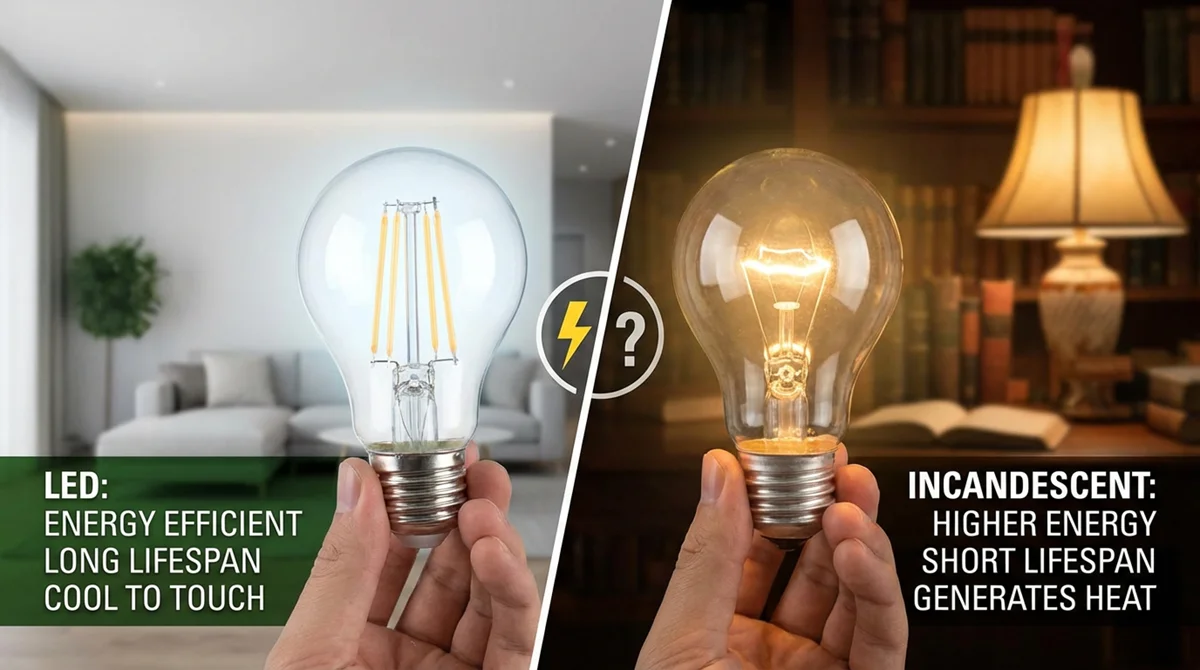
The main difference is how they produce light. Incandescent bulbs heat a wire filament until it glows (inefficient, hot), while LEDs pass electrons through a semiconductor (efficient, cool).
If you’re reading this, you’re probably holding a burned-out bulb or standing in a store aisle wondering what all the numbers mean.
Can I Put an LED Bulb in an Incandescent Fixture?
Yes. You can use LED bulbs in incandescent fixtures safely, provided the LED’s actual wattage is lower than the socket’s rating, which it almost always is.
Can I Put a 100 Watt LED in a 60 Watt Socket?
Yes, this is safe. A “100-watt equivalent” LED only uses about 14–17 watts of actual power. The “60-watt” warning on your socket refers to heat and power draw, not brightness. Since 17W is much lower than 60W, there’s no risk of overheating the wiring.
Warning: Never put a real 100-watt incandescent bulb in a 60-watt socket.
Do LED Lights Work With Old Wiring?
Yes, LEDs actually reduce the strain on old wiring because they draw significantly less current.
The exception is dimmers. Old wiring is fine, but old dimmer switches are not. If your LEDs buzz or flicker, the issue is likely an incompatible dimmer switch, and you may need help installing an LED-compatible dimmer.
While LEDs reduce strain on older electrical systems, if your lights flicker constantly, it may be a sign your board needs inspection.
The Socket Safety Checklist
Before you install that new bulb:
- Read the rating on the fixture socket (e.g., “Max 60 Watts”)
- Look at the LED packaging for “Actual Wattage” (usually 9W, 14W, or 16W)—ignore the “Equivalent” number
- Is Actual Wattage lower than Socket Rating? You’re safe to proceed
- Is the fixture fully enclosed (glass dome)? Check the LED packaging says “Suitable for Enclosed Fixtures”
A note on downlights: The rules above apply to standard light fixtures with replaceable bulbs. Downlights are different — many modern downlights are integrated LED units with no replaceable bulb, meaning you can’t just swap in a new globe when one burns out. If you’re upgrading old halogen or incandescent downlights, our guide to replacing downlights covers whether you can DIY the swap, what it should cost, and when you need a licensed electrician.
What Is the LED Equivalent to a 60 Watt Bulb?
To replace a 60-watt incandescent, look for an LED rated at 800 lumens. Wattage is no longer a reliable way to measure brightness.
Is 800 Lumens Equivalent to 60 Watts?
Yes. This is the industry standard for general-purpose lighting.
LED to Incandescent Conversion Chart
Screenshot this for your next trip to Bunnings:
| Incandescent (Old) | Brightness Needed | LED Actual Watts | Best For |
|---|---|---|---|
| 40 Watt | 450 Lumens | 6-9W | Bedside lamps, relaxing spaces |
| 60 Watt (Standard) | 800 Lumens | 9-12W | Living rooms, reading |
| 75 Watt | 1100 Lumens | 13-16W | Kitchens, bathrooms |
| 100 Watt | 1600 Lumens | 16-20W | Garages, high ceilings. 1600 Lumens is incredibly bright, making it ideal for garages or outdoor security lighting. |
What to do: Check the top of your old bulb. If it says “60W,” ignore the watts on the new box and look for the number 800.
What Is the Main Disadvantage of LED Lights?
The main disadvantage is the potential for “blue light” exposure and harshness if you buy the wrong colour temperature. Cheap LEDs may also flicker, which can cause eye strain.
Is Incandescent Better for Eyes?
Incandescent bulbs naturally emit a warm, steady light (2700K) which is relaxing for eyes. Early LEDs were too blue and cool.
Modern LEDs are just as good for eyes if you buy “Warm White” (2700K–3000K) and choose quality brands with high CRI ratings to avoid flicker.
Why Do People Prefer Incandescent Bulbs?
Three reasons keep incandescents popular:
Aesthetics. They dim smoothly to a warm amber glow, the “sunset effect” that LEDs struggle to replicate.
Upfront cost. Incandescents are cheaper to buy, though they cost more to run over time, a key consideration if you are looking for ways to save on electricity.
Colour rendering. Incandescents have a perfect CRI score of 100, meaning colours look completely natural under the light.
Room-by-Room Colour Temperature Guide
Match the Kelvin (K) number to the room to avoid turning your living room into a hospital ward:
Living room and bedroom: Buy 2700K–3000K (Warm White). For a cleaner look in living areas, many homeowners are switching to LED downlights which provide even, dimmable coverage.
Kitchen and bathroom: Buy 3500K–4000K (Cool White/Neutral)
Garage and home office: Buy 5000K (Daylight)—but be warned, this can feel harsh at night
How to Tell if Lights Are LED or Incandescent
The fastest way is the heat test (carefully) or visual inspection of the filament.
The Heat Test
Turn the light on for two minutes, then turn it off and hover your hand near the bulb.
Incandescent: Radiates intense heat immediately. Too hot to touch.
LED: Warm, but usually safe to touch near the top. The base may be warm.
The Filament Look
Incandescent: Look through the clear glass. You’ll see a thin wire coil held up by metal prongs.
LED: Often frosted plastic where you can’t see inside. If clear, you’ll see yellow strips or a flat circuit board at the base.
The Weight Test
Incandescent: Very light, just thin glass and a metal cap.
LED: Noticeably heavier due to the driver and heat sink built into the base.
If you are unsure about your current fixtures or need a professional LED lighting installation, Moonlight Electrical can assist.